If you’ve ever watched an EFI-swapped engine stumble at wide-open throttle and wondered whether it was running too lean (not enough fuel — bad for pistons and valves) or too rich (too much fuel — bad for power and your catalytic converter), you already understand why a wideband AFR gauge is the first instrument a tuner reaches for. AFR stands for air/fuel ratio — the mixture of air and gasoline entering your engine. A wideband sensor reads that ratio across the entire usable range, from a super-rich 10:1 all the way to a dangerously lean 18:1, in real time. A cheap narrowband sensor — the kind every stock car already has — only tells you “rich” or “lean” in a binary flip-flop, like a light switch. A wideband gives you a dimmer. That granularity is what makes closed-loop EFI tuning possible, and it’s also why every serious EFI build, from a first-timer’s FiTech Go Street to a fully mapped Holley HP EFI setup, eventually needs one.
This guide breaks down the two purchasing decisions that trip people up: which sensor to buy and which controller to pair with it. Both decisions affect accuracy, longevity, and how well the data plays with your ECU. We’ll show the math, name the tradeoffs, and end with a clear decision rule so you can move forward with confidence.
The LSU 4.9: Why There’s Really Only One Sensor Worth Buying
The Bosch LSU 4.9 has become the de facto standard wideband oxygen sensor for aftermarket EFI, and for good reason. Engine Labs’ overview of wideband sensor technology notes that the LSU 4.9’s planar ceramic element and integrated pump cell deliver a response time under 100 milliseconds — fast enough to track transient fueling events during aggressive throttle transitions, which is exactly when self-learning systems like the Holley Sniper 2 need accurate feedback to update their fuel tables.
The sensor retails for roughly $28–$35 depending on the supplier and packaging. That price hasn’t moved dramatically in several years, and as of mid-2026, supply-chain normalization has kept stock consistent at major performance retailers. The Bosch part number 17025 (the most commonly referenced OEM-equivalent) is what virtually every reputable controller manufacturer calibrates their hardware against. OnAllCylinders’ sensor explainer makes a point worth repeating: third-party “compatible” sensors exist at lower price points, but controller manufacturers including AEM, Innovate Motorsports, and Wide Band Air consistently state their calibration is validated against genuine Bosch LSU 4.9 units. Using a knockoff can introduce a consistent offset error — your controller might read 14.4:1 when the true mixture is 13.8:1. In a street/strip context, that 0.6-ratio error under load is not theoretical; it’s the difference between a safe tune and detonation.
The practical buy: Source a genuine Bosch LSU 4.9. The price delta versus a generic alternative is roughly $8–$12. That’s not a tradeoff worth making on a build where the next line item is a $1,400 throttle-body injection kit.
Sensor Placement Matters More Than Most Guides Admit
Per the SAE technical paper on wideband lambda measurement (SAE 2001-01-0990), optimal sensor placement is 18–24 inches downstream of the last exhaust collector on a merged header, at a slight upward angle (10–15 degrees off horizontal) to prevent condensate pooling on the ceramic element during cold starts. On a single-plane intake V8 swap with equal-length headers, this usually lands the bung in the collector or the first few inches of the X/H-pipe. On an LS swap with factory manifolds, the pre-cat bung location often works — but verify you’re downstream of any EGR ports if the engine originally had them.
Turbocharged applications are a separate story: mounting pre-turbo reads differently than post-turbo, and most standalone controllers assume atmospheric pressure. Hot Rod’s technical coverage of turbo AFR monitoring notes that uncorrected boost pressure can skew wideband readings by as much as 0.5–0.8 AFR at high boost levels, which is why some tuners run two sensors (one pre-, one post-turbo) or use a wideband controller with built-in MAP-correction capability.
Controller Tiers: $90 Gauge vs. $210 Data Logger vs. $350 ECU-Integrated Unit
The sensor is the cheap part. The controller — the electronics box that heats the sensor to operating temperature, interprets the pump-cell signal, and converts it to a readable output — is where you make the real decision. Here’s how the three common price tiers stack up.
By the Numbers
| Tier | Street Price (mid-2026) | Output Types | Data Logging | ECU Integration |
|---|---|---|---|---|
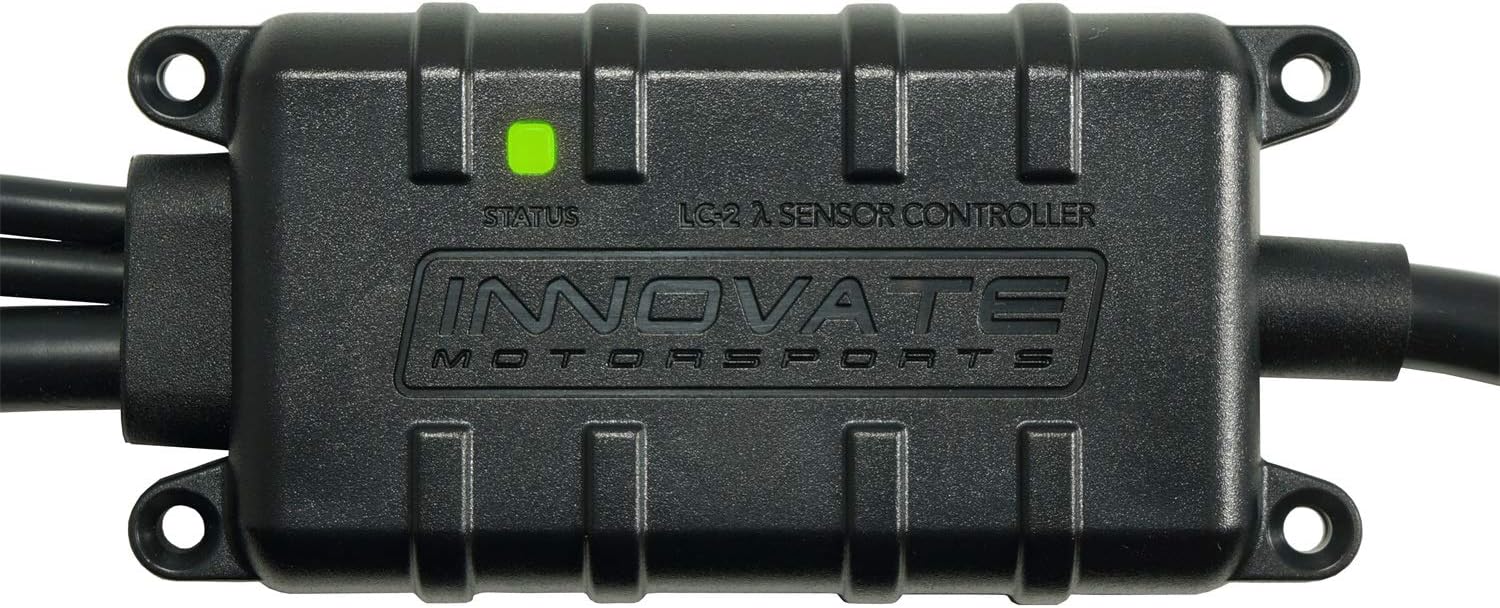
| Entry gauge (e.g., Innovate LC-2 standalone) | ~$90–$120 | Analog 0–5V, serial | No onboard | Analog wire to ECU |
| Mid-range logger (e.g., AEM X-Series UEGO) | ~$200–$230 | Analog 0–5V, CAN bus | SD card / serial | CAN or analog |
| Integrated controller (e.g., Holley 554-101) | ~$290–$350 | Native Holley serial | Stored in ECU | Plug-and-play Sniper/HP |
Entry tier ($90–$120): A dedicated wideband gauge with an analog 0–5V output wire is enough to get the job done on a self-learning throttle-body system. The Holley Sniper 2’s installation guide explicitly supports an external wideband analog input — the ECU reads the 0–5V signal and maps it to AFR. This works. Owners of Sniper 1 and Sniper 2 setups consistently report that a competent analog wideband tightens closed-loop correction and reduces the number of learning cycles needed after an initial startup. The limitation is resolution: a 0–5V analog wire compresses the full AFR range into a voltage signal that introduces small quantization errors. For a street muscle car running 9:1 compression on pump gas, this is a non-issue. For a track car pushing 12.5:1 on E85, it matters more.
Mid-range data logger ($200–$230): Controllers in this tier add SD-card or USB data logging and — critically — CAN bus output. CAN (Controller Area Network) is a digital communication protocol that transmits the exact numerical AFR value rather than an approximated voltage. Engine Labs’ wideband overview specifically calls out CAN-bus integration as the meaningful step-up for builders using Holley HP EFI, MSD Atomic AirForce, or any standalone ECU with CAN input: you get frame-accurate data correlation between AFR, RPM, MAP (manifold absolute pressure), and TPS (throttle position sensor) without having to reconcile analog timestamps. If you’re paying for dyno time to build a custom fuel map, this data quality pays back quickly.
Integrated controller ($290–$350): Holley’s own wideband kit for the Sniper and HP EFI product lines uses a proprietary serial connection that feeds AFR data directly into the Holley ECU’s internal data log. The practical advantage is that you eliminate the analog conversion entirely and get AFR displayed natively on the Sniper’s LCD or the HP EFI laptop software without any additional wiring math. Builders deep in the Holley ecosystem report appreciating the plug-and-play nature; the tradeoff is that if you move to a different ECU platform later, the controller’s native integration advantage disappears.
When the Wideband Connects to Your Self-Learning ECU — and When It Doesn’t Need To
Here’s a distinction that trips up a lot of first-time EFI converters: a wideband AFR gauge and a wideband-to-ECU input are not the same thing.
A gauge sitting on your dash and reading 14.2:1 at cruise tells you the mixture is correct. That’s useful for diagnosis and for sanity-checking a tune during initial startup. But the ECU’s self-learning algorithm only gets smarter if it can read the wideband data itself. The Holley Sniper 2, as documented in Holley’s installation guide, uses its internal narrowband O2 sensors at idle and light cruise for closed-loop correction, but explicitly supports an external wideband input for full-throttle learning above the narrowband’s useful range. If you’re running only a gauge with no analog output wire connected to the ECU, you’re leaving the ECU’s wide-open-throttle learning disabled. That’s a real gap on a performance build.
The practical setup that OnAllCylinders’ guide on self-learning EFI systems recommends for Sniper-class builds: run a mid-tier controller with both the analog output wired to the ECU and a display gauge in the dash. You get ECU learning at all throttle positions and a human-readable readout during tuning sessions. Total hardware cost: $200–$230 for the controller, $29–$35 for the sensor, and a couple of hours for bung welding and wiring. That’s roughly $260 all-in before installation.
The Bung Install: One Step You Cannot Skip
A wideband sensor needs a dedicated stainless or mild-steel bung welded into the exhaust. Do not use a compression-fit or clamp-on sensor adapter for a permanent installation — thermal cycling will cause them to migrate or leak, and exhaust leaks corrupt sensor readings by introducing fresh oxygen into the exhaust stream. Hot Rod’s exhaust fabrication coverage consistently emphasizes the same point: a welded -18 x 1.5mm bung is the only permanent solution. If you don’t weld, most exhaust shops charge $25–$60 to add a bung to an existing system. It’s the cheapest part of the entire project.
The Decision Rule: Which Tier Is Right for Your Build?
You’ve been patient with the detail — here’s the “if X, then Y”:
If you’re running a self-learning TBI kit (Sniper 1, Sniper 2, FiTech Go Street) on a street driver: Buy a genuine Bosch LSU 4.9 ($29–$35) and a mid-range analog/CAN controller (~$210). Wire the analog output to the ECU’s wideband input. Total: ~$240. This setup closes the loop at all throttle positions and gives you a data log you can actually use.
If you’re in the Holley HP EFI / Dominator ecosystem building a custom fuel map: Step up to either the CAN-bus mid-tier controller or Holley’s native wideband kit (~$290–$350). The data quality improvement justifies the price when you’re paying for professional dyno time.
If you’re turbocharged or running E85 above 600 whp: Add MAP-corrected wideband capability to your spec list. Innovate Motorsports and AEM both publish MAP-correction firmware or hardware add-ons for their respective controllers. Do not skip this — the uncorrected reading error at boost pressure is not small enough to tune around.
If you just want a sanity-check gauge during a carb-to-EFI learning period, with no ECU integration: The entry-tier gauge (~$100 all-in with sensor) is honest money. Just know it’s a diagnostic tool, not a tuning tool, until you wire the output to the ECU.
The sensor is never the variable. Buy the real Bosch. The controller is where you match the spend to the application — and as the numbers above show, even the step-up tier lands well inside a $300 total investment on a build where the ECU alone costs ten times that.