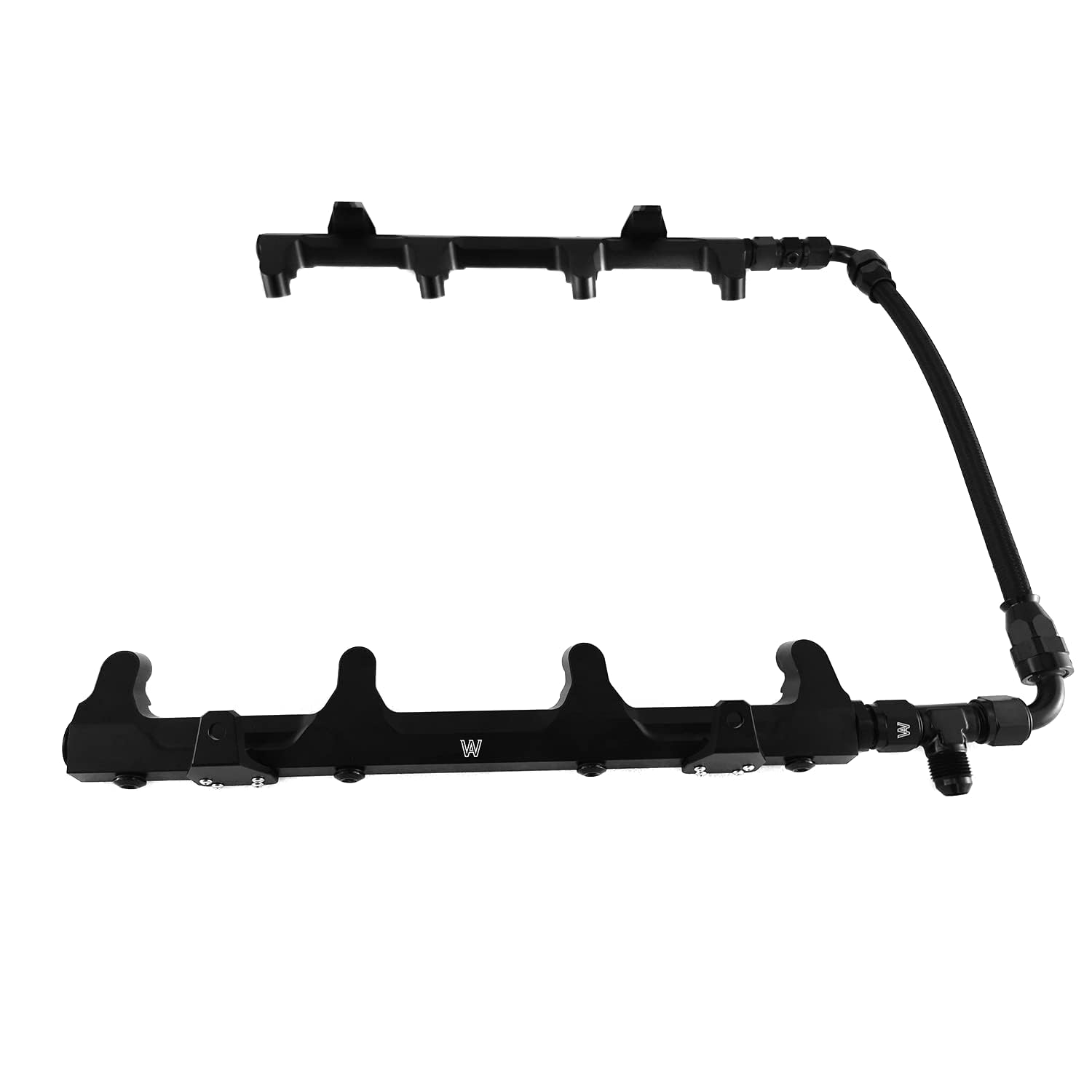
If you’re dropping an LS engine — General Motors’ legendary small-block V8 family, produced from 1997 to the present — into a classic muscle car or pro-touring build, you’ve probably focused most of your energy on the engine itself, the mounts, and the transmission. But there’s one system that quietly determines whether your build runs clean at the track or leaves you chasing a stumble at 6,000 rpm: the fuel delivery circuit. Unlike the simple, low-pressure carbureted systems these cars originally ran, an LS engine demands a tightly regulated 58 PSI (pounds per square inch) of fuel pressure at all times, delivered through a return-style circuit — meaning excess fuel loops back to the tank rather than dead-ending at the injectors. Get this right, and your LS breathes easy from idle to redline. Get it wrong, and no amount of tuning will fix the pressure drop that starves your engine when it matters most. This guide walks you through every component in that circuit, names the tradeoffs, and ends with a clear buying framework.
Why 58 PSI and Why Return-Style Matters
Most carbureted fuel systems run 6–7 PSI with a mechanical pump. The jump to 58 PSI isn’t arbitrary — it’s what GM’s factory LS injectors are calibrated to operate at, and it’s what every major aftermarket ECU (engine control unit, the brain of your EFI system) expects as its baseline when calculating injector pulse width (how long each injector stays open per firing event). Per Holley Performance’s LS swap documentation, deviating more than a few PSI from that target introduces fueling error that the ECU’s closed-loop correction tables can partially compensate for at part throttle — but cannot fully correct during hard acceleration transients.
A return-style system solves the heat-soak and demand-surge problem that would otherwise plague a dead-head (no-return) setup. Here’s the logic: your fuel pump is always flowing more fuel than the engine needs. The regulator holds 58 PSI at the rail and bleeds excess fuel back to the tank through a dedicated return line. Because fuel is continuously circulating, heat doesn’t build up in the rail. Pressure stays stable. Engine Labs’ coverage of LS fuel system basics confirms that a properly sized return circuit maintains rail pressure within ±1–2 PSI even during wide-open throttle pulls on a 500+ horsepower combination — numbers a dead-head system simply can’t match at elevated power levels.
The practical implication: if your donor car ran a dead-head carb fuel system, you’re adding a return line. That’s the single most common oversight on first-time LS swaps, and it’s worth planning before the body is back on the car.
The Four Components You’re Actually Specifying
Think of the return circuit as four interdependent pieces. Sizing any one of them independently without considering the others is where builds go wrong.
1. The Fuel Pump
Your pump has to deliver adequate volume (measured in liters per hour or gallons per hour) at 58 PSI. Pressure and volume are not the same thing — a pump can hit 58 PSI but run out of volume under load, causing rail pressure to sag. Hot Rod Magazine’s LS swap fuel system coverage uses a practical rule of thumb: estimate 0.5 lb/hr of fuel per horsepower at a brake-specific fuel consumption (BSFC) of 0.50, then add 25% headroom for pump aging and real-world heat.
By the numbers:
- 400 hp LS build: ~200 lb/hr fuel demand → target pump rated at ~250 lb/hr at 58 PSI
- 600 hp LS build: ~300 lb/hr fuel demand → target pump rated at ~375 lb/hr at 58 PSI
- 1 gal/hr ≈ 6.17 lb/hr (E10 pump gas at ~6.17 lb/gal)
In-tank pumps (drop-in modules or hat-style hangers) are strongly preferred for return-style LS swaps because they stay submerged in fuel, which keeps them cool and quiet. External inline pumps work, but require careful heat management and priming circuit design. Per OnAllCylinders’ regulator overview, undersized pumps are the leading cause of high-RPM fuel pressure drop complaints on otherwise correctly assembled LS swap fuel systems.
2. The Fuel Rail
Factory LS engines use aluminum rails sized for their factory injector flow rates. On a stock Gen III or Gen IV LS (think 4.8L truck engine through LS3), the OEM rails are adequate for naturally aspirated power levels. Once you’re adding boost, nitrous, or upgraded injectors, rail sizing becomes a real conversation.
The key metric is rail volume — a larger internal bore holds more fuel in reserve, acting as a small accumulator that buffers sudden demand spikes. Aftermarket billet aluminum rails from brands like FAST, Aeromotive, and Holley are available in -6AN and -8AN inlet configurations. For most street/strip LS builds under 700 hp, -6AN (3/8-inch line equivalent) feed and return is the published consensus recommendation. Above 700 hp on E85 or forced induction, -8AN (1/2-inch equivalent) becomes the appropriate spec, as confirmed in Holley’s fuel system sizing documentation.
One underappreciated spec: rail material thermal expansion. Aluminum rails expand and contract with heat cycles. Quality billet units with proper end-cap sealing are far less likely to develop seeping joints after hundreds of heat cycles than economy cast units. Motor Trend’s pro-touring fuel system coverage specifically calls out rail end-cap seal quality as a long-term reliability differentiator on track-driven builds.
3. The Fuel Pressure Regulator
This is the most critical — and most frequently misspecified — component in the circuit. The regulator’s job is to maintain 58 PSI at the rail regardless of how hard the engine is demanding fuel. On a return-style system, you want a bypass-style regulator (also called a deadhead-bypass or reference-style regulator). It holds the set pressure and bypasses excess fuel to the return line. This is fundamentally different from a rising-rate regulator, which is designed for forced-induction applications where fuel pressure increases proportionally with boost pressure.
For a naturally aspirated LS swap: a vacuum-referenced bypass regulator set to 58 PSI is correct. Vacuum reference (a small port that connects to intake manifold vacuum) allows the regulator to maintain fuel pressure differential across the injector constant — as manifold vacuum drops at WOT (wide-open throttle), the regulator marginally increases absolute rail pressure to compensate. The result is that injector differential pressure stays consistent, making your ECU’s fuel calculations accurate across the RPM range.
For a boosted LS swap: a boost-referenced rising-rate regulator raises fuel pressure 1:1 with boost pressure, maintaining that same differential across the injector under positive manifold pressure. Per Engine Labs’ fuel system fundamentals coverage, failing to run a boost-referenced regulator on a forced-induction LS build causes injectors to effectively flow less fuel per pulse under boost — a lean condition that can be catastrophic at high boost levels.
Aeromotive’s A1000 and Holley’s billet EFI regulators are consistently cited across published LS swap build threads and editorial coverage as reliable, rebuildable units that hold set pressure within the ±1–2 PSI window at full-load conditions. The Aeromotive 13109 (adjustable, -6AN, rated to 1,200 hp at 43–90 PSI) and Holley 12-846 (non-adjustable, pre-set to 58 PSI for LS applications) represent the two common specification philosophies: adjustable for tuners who want flexibility, pre-set for builders who want one fewer variable.
4. The Feed and Return Lines
Line sizing follows rail sizing: -6AN feed and return for sub-700 hp naturally aspirated builds, -8AN for anything above. The critical installation detail is that the return line must flow freely back to the tank with no kinks, no sharp 90-degree bends with undersized fittings, and no routing that creates back-pressure. Any restriction in the return path raises effective rail pressure above your regulator’s set point — the opposite of what you want.
PTFE-lined stainless braided hose (often branded as Fragola, Aeroquip, or Russell in builder documentation) is the standard spec for under-hood and chassis routing. It handles fuel compatibility across pump gas, E85, and methanol without liner degradation. Plain rubber hose is not adequate for long-term use in a 58 PSI EFI system and is specifically called out as a failure point in OnAllCylinders’ EFI fuel system overview.
Matching the System to Your Build: The Decision Framework
Here’s where the math and the tradeoffs converge into a clear “if X, then Y” framework. This is the decision logic that separates a system spec’d to last 100,000 miles from one that gets rebuilt at year two.
If your build is: Naturally aspirated LS, 350–500 hp, street/strip use
- Pump: In-tank unit rated 250–300 lb/hr at 58 PSI (Walbro 450, Deatschwerks DW300C are commonly specified at this tier)
- Rails: Factory LS rails or billet aftermarket with -6AN inlets
- Regulator: Vacuum-referenced bypass, pre-set or adjustable to 58 PSI (Holley 12-846 or Aeromotive equivalent)
- Lines: -6AN PTFE braided feed and return
If your build is: Forced-induction or N2O LS, 500–700+ hp
- Pump: Dual in-tank setup or single high-flow unit rated 400+ lb/hr at 60 PSI (Aeromotive Phantom 340 or Fuel Surge Tank systems are published specs at this level)
- Rails: Billet aftermarket, -8AN inlets with adequate volume
- Regulator: Boost-referenced rising-rate (Aeromotive 13129, Holley 12-848 boost reference unit)
- Lines: -8AN PTFE braided feed and return, with surge-tank consideration for hard cornering applications
If your build is: Endurance road racing or sustained high-load events
- Add a fuel surge tank (a small 1–2 liter buffer reservoir that feeds the high-pressure pump regardless of chassis-level fuel slosh). Per Motor Trend’s pro-touring coverage, surge starvation during extended cornering loads is the primary fuel system failure mode in road-racing LS builds — not pressure regulation. Addressing it at the design stage costs far less than diagnosing it at the track.
The Spec You Can’t Skip: Testing Before You Tune
Before you log a single lap or make a pull on the dyno, install a mechanical fuel pressure gauge with a 0–100 PSI range directly at the fuel rail — not inline in the feed line, but at the rail itself. Log pressure at idle, at cruise, and during a wide-open throttle pull. You’re looking for stable 58 PSI at idle (or slightly below with vacuum reference), consistent pressure through the pull, and no sag at peak RPM. Published guidance from Holley and Engine Labs both cite a pressure sag of more than 3–4 PSI at WOT as a signal that pump volume is insufficient for the demand — and that sag will always be worse when the car is hot and the fuel is near the bottom of the tank.
Only after confirming pressure stability under load should you start evaluating injector timing, fuel trim, and ECU tune. A stable fuel system is the foundation that makes every other calibration decision meaningful. Without it, you’re tuning against a moving target — and that’s the one scenario where no self-learning ECU, regardless of price, can reliably save you.
Build the circuit right once. The track will tell you if you did.