Injector Rebuild Kit vs. New Injector Set: A Practical Cost-Benefit Guide for LS and Small-Block Builders
If you’ve never dealt with fuel injectors before, here’s the short version: a fuel injector is a small electronically controlled valve that sprays a precise mist of gasoline into your engine. Over time — especially on high-mileage trucks, barn-find muscle cars, and anything that sat with old fuel in the system — these injectors get dirty, their rubber seals dry out and crack, or their internal spray patterns degrade. When that happens, you get misfires, rough idle, poor fuel economy, or a check-engine light that won’t quit. You’ve got two options to fix it: buy a rebuild kit (fresh seals, filters, and pintle caps to overhaul the originals) or swap in a brand-new set of replacement injectors. This guide is going to show you exactly when each path makes sense, what it actually costs, and how to avoid the mistakes that send builders back to the parts store a second time.
| EDITOR'S PICKTRQ MPI FI Fuel Injector Set of… | Mid-tierFuel Injectors 0280158233 Compa… | Budget pickHiSport Fuel Injector Seal Kits… | |
|---|---|---|---|
| Type | New injector set | New injector set | Rebuild seal kit |
| Quantity | 8 | 6 | 8 sets |
| Vehicle fit | GM V8 2000-2007 | 3.6L 2011-2017 | — |
| Injector holes | — | 4 | — |
| O-rings included | — | — | ✓ |
| Removal tool | — | — | ✓ |
| Price | $164.95 | $44.64 | $16.77 |
| See on Amazon → | See on Amazon → | See on Amazon → |
The Core Tradeoff: What You’re Actually Buying with Each Approach
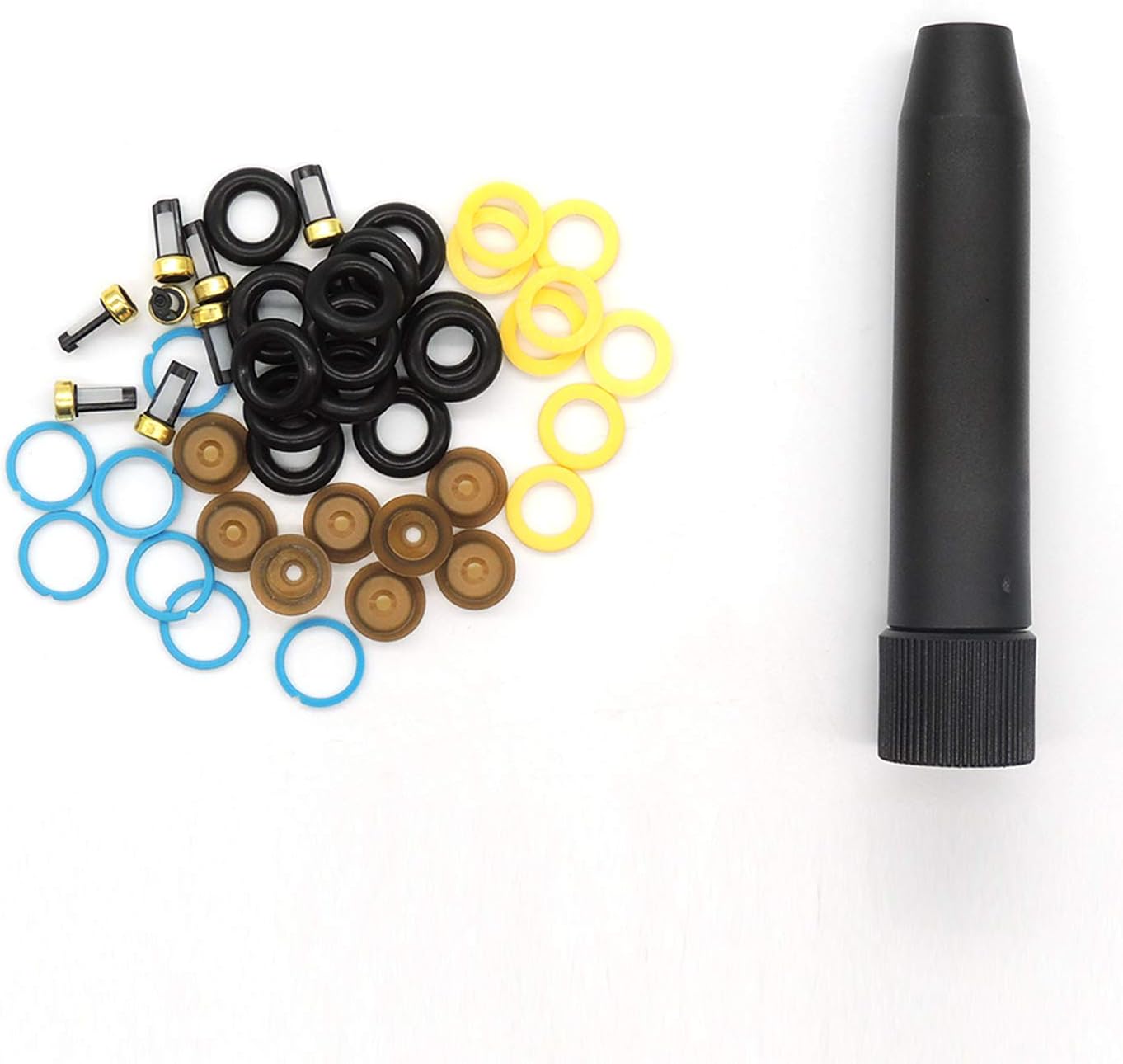
A rebuild kit — sometimes called an injector service kit — typically contains O-rings (the rubber seals at the top and bottom of each injector), pintle caps (the tiny plastic tip that shapes the spray cone), micro basket filters (fine-mesh screens that trap debris before it reaches the injector’s needle valve), and sometimes a filter removal tool. The goal is to renew the sealing surfaces and flow path without replacing the injector body itself.
What a rebuild kit cannot fix is mechanical or electrical damage inside the injector. If the solenoid coil has weakened, if the needle valve is scored, or if the spray pattern has degraded from years of fuel varnish baked onto internal surfaces, fresh O-rings will restore leak-free sealing but leave the underlying problem untouched. Engine Labs’ overview of fuel injector flow dynamics makes this point clearly: an injector with a compromised atomization pattern will still misfire and cause uneven cylinder fueling even after a full seal replacement.
OnAllCylinders’ guide to diagnosing bad injectors reinforces the diagnostic hierarchy: start with a resistance check (a healthy injector typically reads 12–16 ohms on a high-impedance unit, 2–5 ohms on a low-impedance performance unit), then listen for consistent clicking with a mechanic’s stethoscope at idle, and only after that decide whether a service or replacement is warranted.
The honest decision split:
- Rebuild kit = right call when injectors are mechanically sound but leaking externally, showing vacuum-related seal failure, or receiving preventive service during an engine-out job.
- New injector set = right call when spray pattern testing (or a persistent cylinder-specific misfire that swapping injectors confirms) points to internal injector failure.
By the Numbers: Rebuild Kit vs. Replacement Set
| Path | Typical Cost (2026) | Labor Demand | Risk of Repeat Visit |
|---|---|---|---|
| 8-injector rebuild kit (LS V8) | $18–$45 | Moderate — seal fitment is skill-sensitive | Medium if micro baskets are misinstalled |
| Budget replacement set (LS 4.8/5.3) | $80–$160 | Low — direct swap | Low if part number is confirmed |
| OEM-spec remanufactured set | $180–$320 | Low | Very low |
| Professional flow-bench service | $120–$200 (shop rate) | None (shop handles) | Low |
These ranges are based on aggregated pricing across major parts platforms as of May 2026. Per-injector pricing varies significantly by application — Ford modular and Mopar Hemi injectors tend to run slightly higher than GM LS equivalents in the replacement-set category.
Where Rebuild Kits Earn Their Money (and Where They Don’t)
The HiSport rebuild kit has accumulated a noteworthy owner track record for one specific reason: the included filter removal tool. Pulling the micro basket filter out of an injector body without the correct tool almost always means damaged filter housings or a filter that goes back in crooked — and a crooked filter is worse than no filter at all, because it restricts flow unevenly across the injector’s cycle. Owners consistently praise this tool inclusion as the kit’s most practical differentiator over generic seal packs.
But the same owner pool tells a cautionary story. Across multiple aggregated reviews, a recurring pattern emerges: two injectors in a given set required outright replacement even after the rebuild kit did exactly what it promised. The seals were renewed, the filters were fresh — but those two injectors were simply dead inside. The rebuild kit didn’t fail; it just couldn’t resurrect them. If you’re working through eight LS injectors hoping the kit fixes all eight, budget for the real possibility that one or two will still need to come out.
The GM-specific kit designed for applications like the Silverado 4.8 surfaces the most detailed cautionary feedback of any rebuild product in this category. Owners who work through the process carefully report success, but the micro basket filter reinstallation step is consistently flagged as the article’s most consequential detail. One Silverado owner’s documented experience — the vehicle required a return shop visit after incorrect basket reinstallation caused a flow restriction — makes the skill threshold explicit: this is not a casual afternoon job. If you haven’t done injector seals before, plan for a dry run on a parts-store core before you touch your running engine.
Popular Mechanics’ discussion of rebuild-vs.-replace decisions in engine components frames the broader principle well: a rebuild is cost-effective when the failure mode is external (seals, gaskets, surface wear) and the core component retains its precision geometry. The moment internal dimensional integrity is in question, replacement becomes the better return on labor hours.
New Budget Sets: Better Than Their Price Suggests, With One Fitment Warning
The narrative on budget replacement injector sets has shifted meaningfully over the past two years. For Ford and Mopar applications specifically, owners consistently report that budget replacement sets resolved misfires that parts-store diagnostic scans had failed to attribute to the injectors at all. The fix, in multiple documented cases, was cheaper than a single shop visit for injector cleaning — and the injectors arrived with O-rings pre-installed, which eliminates one of the assembly steps that trips up first-time installers.
A-Premium injector sets for Ford applications and Mopar-compatible replacement sets have both accumulated reviews from skeptical buyers who describe the build quality as exceeding their expectations at the price point. The O-ring pre-installation detail keeps showing up in these reviews because it’s a genuine time-saver and reduces the chance of a pinched or cross-threaded seal during installation.
The TRQ GM injector set deserves an explicit fitment correction here, because a real owner documented exactly the failure mode you want to avoid: this set was installed in a 2.2L four-cylinder application by a buyer who didn’t verify the part number against their specific engine. It still ran — but “it ran anyway” is not a fitment confirmation. The TRQ GM set is designed for V8 applications, and the flow rate and impedance specs are matched to those engines. Installing a V8-spec injector in a 2.2L four-cylinder means the ECU is running closed-loop fuel trim against an injector with the wrong baseline flow characteristics. Even if it starts and idles, you’re leaving power and efficiency on the table and potentially stressing the long-term fuel trims. Confirm your OEM injector part number before ordering any replacement set — the FAQ section below covers exactly how to do that for GM V8 applications.
MotorTrend’s LS engine buyer’s guide notes that the 4.8, 5.3, and 6.0 LS family shares many hardware dimensions but carries meaningfully different injector flow rates matched to each displacement’s fuel demand. An injector swap between these families is not a neutral substitution even though the physical connector and body dimensions may look identical on the shelf.
The Shop-Service Option: When Neither Kit Nor Budget Set Is the Right Move
If you’re building a pro-touring car or a street/strip engine where flow balance between cylinders matters — and it does matter, because uneven injector flow shows up as AFR scatter on a wideband even with a self-learning ECU correcting for it — neither a DIY rebuild kit nor a budget replacement set is your best path. A professional injector flow-bench service, where each injector is ultrasonically cleaned, flow-tested, and matched within a tight tolerance window, gives you data the other two options don’t. Hot Rod Network’s LS fuel system planning coverage makes this point in the context of high-horsepower builds: matched injector sets reduce the AFR variation that a Holley HP EFI or similar closed-loop system has to correct for, which in practice means cleaner power delivery and less fuel trim hunting at part throttle.
The cost math for a shop service sits between a rebuild kit and a new OEM-spec set — but the output is a documented flow number per injector, which is worth real money on a build where you’re paying for dyno time anyway.
Frequently Asked Questions
Can I rebuild LS injectors myself without an ultrasonic cleaner?
Yes, for a seal-and-filter service — which is the scope of a rebuild kit — you don’t need an ultrasonic cleaner. Ultrasonic cleaning addresses internal varnish deposits on the needle and seat; a rebuild kit addresses external sealing surfaces and the micro basket filter. If your injectors are mechanically sound and your goal is a preventive service during an engine-out build, a rebuild kit and careful assembly technique is a legitimate DIY path. If you suspect internal varnish from degraded fuel, a shop ultrasonic service is the only way to address it without replacing the injectors outright.
How do I know if my injectors need a rebuild or full replacement?
Start with a resistance test (multimeter across the injector terminals — compare your reading against the factory spec for your application). Then listen for consistent clicking at idle with a mechanic’s stethoscope. If one injector is silent or clicking erratically, it’s electrically failed and no rebuild kit will fix it. If resistance and clicking check out but you still have a cylinder-specific misfire, swap the suspect injector to a different cylinder and see if the misfire follows it — if it does, that injector has an internal flow or spray-pattern problem and needs replacement, not rebuilding. OnAllCylinders’ injector diagnosis guide walks through this process in detail.
Are budget replacement injector sets safe for a daily-driven truck or SUV?
Based on aggregated owner feedback across Ford, Mopar, and GM applications, budget replacement sets from established brands have consistently resolved driveability issues and held up in daily-driven applications. The critical step is confirming the correct part number for your specific engine — not just make, model, and year, but engine displacement and sometimes build date. Pre-installed O-rings on quality budget sets reduce installation errors. If you’re maintaining a warranty or a CPO vehicle, verify that the replacement spec matches OEM flow rates.
What is the micro basket filter in an injector rebuild kit and why does it matter?
The micro basket filter is a fine-mesh screen that sits at the inlet of the injector body and catches particulate debris before it reaches the needle valve and seat. Over time these filters can clog with varnish or rust particles, restricting flow. A rebuild kit replaces this filter — but the removal and reinstallation step is the most skill-sensitive part of the job. Incorrect reinstallation (cross-seated, tilted, or incompletely seated) creates a flow restriction that can be worse than the original clogged filter. Use the correct removal tool, work slowly, and confirm the filter is fully seated and square before reassembly.
How do I confirm the correct OEM injector part number for my specific GM V8 application before ordering?
Pull your VIN and use GM’s official parts lookup (ACDelco.com parts catalog, or a GM dealer parts counter) to cross-reference the injector part number to your exact engine RPO code — not just “5.3L LS” but the specific RPO (e.g., LM7, LMG, L99). The RPO code is on the sticker inside your glovebox or door jamb. LS-family injectors share physical dimensions but carry different flow rates; the RPO code is the only reliable way to confirm you’re matching the factory fuel calibration your ECU expects.
The decision rule: If your injectors pass a resistance test and cylinder-swap test, the seals are weeping, and the engine is already apart — a quality rebuild kit is a legitimate, cost-effective service. If you have a confirmed dead injector, a spray-pattern failure, or you’re building for performance where matched flow balance matters, put that rebuild kit money toward a budget replacement set or a shop flow-bench service instead. The kits are real tools; they just have a specific job. Know which job you’re actually trying to do before you order.