If you’re converting a carbureted muscle car or classic truck to electronic fuel injection (EFI), one of the first things you’ll discover is that EFI systems are fussier about fuel pressure than carbs ever were. Where a carburetor runs happily at 5–7 PSI, most throttle-body and port-injection EFI setups want to see a steady 58 PSI — and they want it maintained under hard acceleration, not just at idle. That means your old mechanical fuel pump has to go, and you need an inline electric pump paired with a regulator (a device that limits fuel pressure to the target number and, on return-style systems, routes excess fuel back to the tank). Evil Energy has become one of the most-discussed budget brands in this space, selling both standalone pumps and combination kits that bundle the pump with an integrated filter-regulator unit. This article compares their PTFE-lined hose combo kit against their CPE (cross-linked polyethylene) variant, digs into what real owners actually experience, and gives you a clear decision framework before you buy.
| EDITOR'S PICKEVIL ENERGY EFI Fuel Pressure R… | Mid-tierEVIL ENERGY External Inline Fue… | Budget pickEVIL ENERGY External Inline Fue… | |
|---|---|---|---|
| Regulator included | ✓ | — | — |
| Pressure range | 20-120 PSI | — | — |
| Gauge included | ✓ | — | — |
| Hose fitting size | 6AN | — | — |
| Pump flow rating | — | 300 LPH | 300 LPH |
| Bracket included | — | ✓ | — |
| Price | $98.99 | $65.99 | $60.99 |
| See on Amazon → | See on Amazon → | See on Amazon → |
What “PTFE vs. CPE” Actually Means — and Why It Should Influence Your Pick
PTFE (polytetrafluoroethylene, the same chemistry as Teflon) and CPE (cross-linked polyethylene) are the two dominant hose liner materials you’ll encounter in budget EFI fuel line kits. The distinction matters more than the marketing suggests.
PTFE-Lined Hose: The Fuel-Compatible Choice
PTFE-lined hose is chemically inert, meaning it won’t degrade when exposed to ethanol-blended fuels, oxygenated race fuels, or the aromatic hydrocarbon content of modern pump gasoline. The PTFE liner doesn’t swell, doesn’t contribute to fuel odor permeation, and won’t shed particulate into the fuel stream over time. SAE International’s fuel hose construction standards — specifically SAE J30 and SAE J1527 — both recognize PTFE as the preferred liner material for fuel systems where long-term fuel compatibility is a concern. For builders running E85, operating in high underhood temperatures, or simply wanting a one-time install with no revisits, PTFE is the correct liner choice.
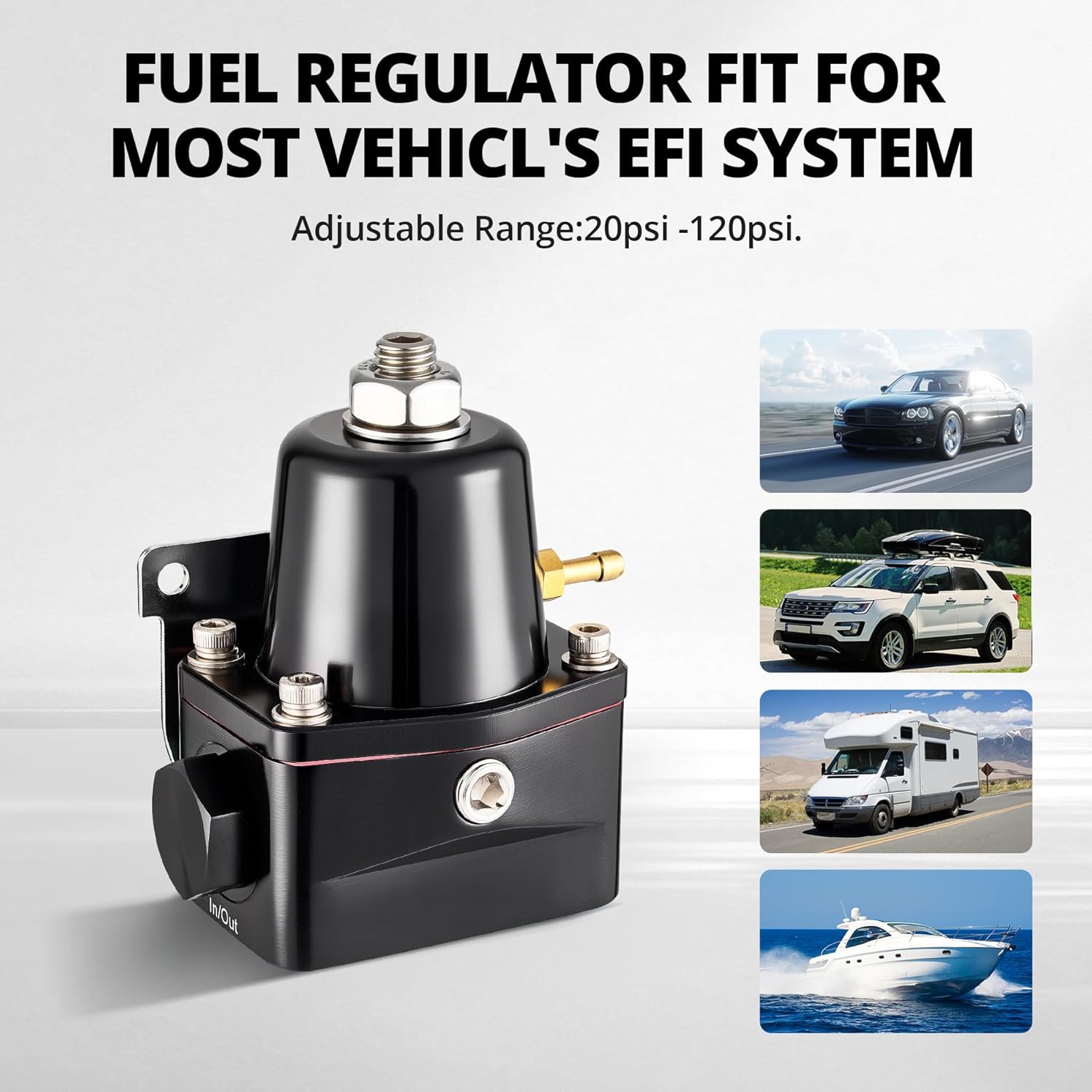
EVIL 20-120PSI
$98.99
In stock on Amazon
Check price on AmazonCPE Hose: The Budget-Conscious Starting Point
CPE hose is more flexible, easier to route in tight engine bays, and meaningfully less expensive to manufacture. For a street-driven build running 87–93 octane pump gas with no E85 in the mix, CPE performs adequately in moderate-temperature environments. Where CPE starts to show its limits: sustained ethanol exposure, prolonged high underhood heat cycles, and high-vibration environments where liner integrity matters more than initial cost savings.
The practical takeaway: if you’re planning to run E85, drag racing, or simply want to install it once and forget it, the PTFE combo kit is the correct call. If you’re doing a light-duty street conversion on a truck or SUV that lives on pump gas and you want to minimize upfront cost, the CPE kit is a reasonable starting point — with the understanding that hose replacement may come sooner than with PTFE.
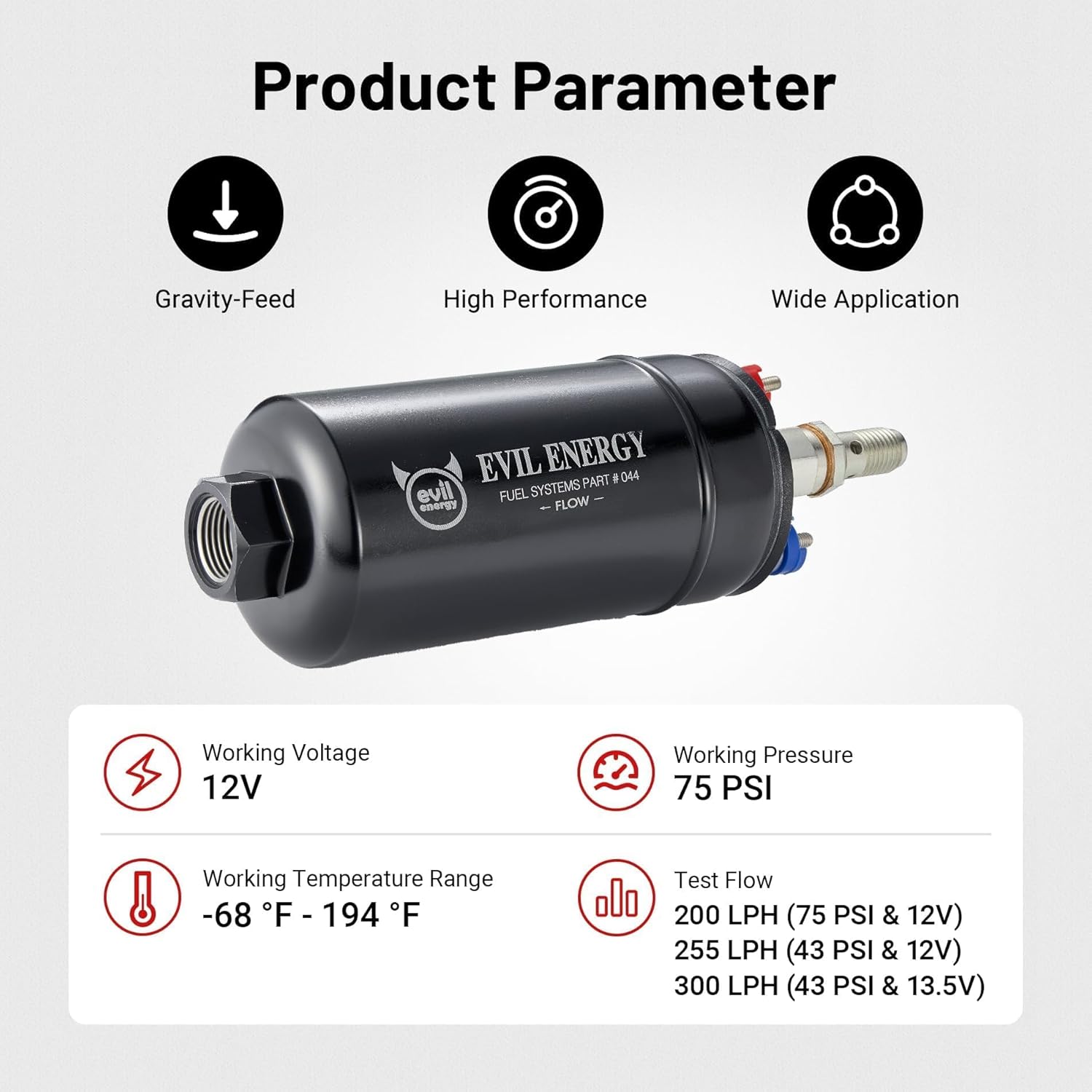
EVIL
$60.99
In stock on Amazon
Check price on AmazonMatching Hose Material to Your Actual Use Case
The marketing language on both kits implies interchangeability. It isn’t. Before choosing based on price alone, answer two questions honestly: What fuel will you run for the life of this build? And what does a mid-build hose replacement actually cost you in labor and downtime? For many builders, the price delta between CPE and PTFE disappears entirely when you account for one hose replacement event over a five-year ownership period.
OnAllCylinders’ editorial “How to Choose a Fuel Pump for Your EFI Build” — a Holley technical editorial covering LPH ratings and brake-specific fuel consumption math — makes the same point about total-cost-of-ownership thinking in EFI fuel system selection: the cheapest component at purchase is rarely the cheapest component over the life of the build.
EVIL
$65.99
In stock on Amazon
Check price on AmazonThe 58 PSI Delivered Pressure Question — What the Numbers Actually Show
“Rated for 58 PSI” sounds definitive. It rarely is, in isolation.
By the numbers:
- Evil Energy 300LPH standalone pump: manufacturer-rated for up to 75 PSI free-flow
- Combo kit integrated filter-regulator: set from the factory to deliver approximately 58 PSI
- One owner-reported anomaly: pump delivering over 80 PSI at a test port before the regulator — documented in aggregated product reviews
That third data point deserves attention. The integrated regulator in the combo kit is doing real work, not just trimming a few PSI off a stable output. If the regulator fails or begins drifting — which happens, particularly in heat-cycled environments — you have uncontrolled fuel pressure upstream of your injectors or throttle body. For any self-learning ECU system like the Holley Sniper 2 or MSD Atomic AirForce, a pressure spike into the 70–80 PSI range can produce dangerously rich conditions that the ECU’s closed-loop correction may not catch fast enough.
The combo kit’s integrated 58 PSI filter-regulator has been specifically praised by EFI conversion builders for its compact, single-unit form factor — it’s a genuinely elegant solution for a firewall-forward or frame-rail mount where you want to minimize plumbing complexity. That use case — moderate street driving, EFI throttle body at factory pressure spec — is exactly where the combo kit earns its keep.
OnAllCylinders’ editorial on EFI fuel pump selection notes that fuel pressure consistency, not just peak flow, is the variable that most affects tuning stability. A pump that delivers 58 PSI ±2 PSI across the RPM range is worth more than one that averages 58 PSI but swings 10 PSI under load. Builds pushing higher horsepower targets or running boost should add an external bypass regulator as a failsafe regardless of what the combo kit includes.
The Longevity Problem — and Where Evil Energy’s Customer Service Changes the Math
Here’s the honest version of the reliability picture, synthesized from aggregated owner reports:
Longevity is the sharpest criticism against the 300LPH standalone unit. Multiple owners report failures inside one year — some within six to eight months. One buyer purchased two units sequentially, experienced failure in both, and documented the pattern. That’s a real signal, not a single outlier.
The counterweight is Evil Energy’s customer service response. Multiple reviewers who experienced pump failure reported that Evil Energy proactively reached out and issued replacements, in some cases even after a negative review was already live and published. For a budget-tier product, that’s meaningfully better than the industry standard of silence. It doesn’t eliminate the failure risk, but it reframes the total-ownership calculus.
MotorTrend’s “LS Swap Buyer’s Guide” notes that fuel system reliability is the variable most commonly underestimated in first-time EFI conversions — builders focus on ECU features and tuning capability, then discover that a cheap pump is the weakest link in an otherwise solid build. That observation applies directly to the Evil Energy standalone unit: the combo kit, which integrates filter and regulator into a single unit, has fewer independent failure-mode reports in owner reviews than the standalone pump, likely because the filtered inlet reduces pump wear from particulate contamination.
The practical decision frame: If your build is a show car that runs 1,000 miles a year and you can tolerate a warranty swap if the pump fails, the price-to-performance ratio holds up. If your build is a daily-driven muscle car or a car that competes at track events where a fuel pump failure mid-run is a real problem, the reliability profile of the Evil Energy 300LPH standalone argues for either the combo kit or stepping up to a more proven unit from a tier-appropriate brand.
Noise: Mounting Matters More Than the Pump Does
Owner reports on noise are genuinely contradictory — and that contradiction is itself the signal.
One reviewer replaced an even louder pump with the Evil Energy unit and called it effectively inaudible in normal driving. Another described the same product category as “almost screaming” after two weeks of use. Both reviewers are likely telling the truth.
Inline electric fuel pumps are fundamentally vibration-generating devices. Mounted directly to a steel frame rail with hard-line fittings, the pump’s operating frequency couples directly into the chassis and resonates through the cabin. The same pump mounted with rubber isolation bushings, flex hose on both the inlet and outlet sides, and a rubber-backed mounting bracket behaves like a completely different product acoustically.
Hot Rod Network’s editorial coverage of EFI swap fuel system basics — published under the title “EFI Swap Fuel System Basics” — consistently recommends rubber-isolated mounting as standard practice for any inline pump, not a premium add-on. If noise is a concern for your build, budget for proper isolation hardware before you install. The pump isn’t the variable; the mount is.
The 6AN Fitting Issue Nobody Documents
This deserves its own callout because it’s the kind of thing that costs you two hours on a Saturday afternoon.
The 6AN version of the Evil Energy combo kit ships with a non-standard outlet fitting that owners describe as a proprietary or transitional connector — it doesn’t mate cleanly with standard 6AN male flare fittings from common AN plumbing suppliers. The fix is removing the included fitting entirely and installing a proper 6AN male fitting in its place. That’s a solvable problem, but it’s not mentioned anywhere in the included instructions, and it requires having the correct fitting on hand before you start.
If you’re ordering this kit, add a 6AN male-to-female adapter or a pair of straight 6AN fittings to your parts list at the same time. Order them when you order the kit — not after you’ve already blocked off Saturday morning for the install.
Frequently Asked Questions
Does the Evil Energy 300LPH pump require a return line, or can it run deadhead with the included regulator?
The combo kit’s integrated filter-regulator is designed for a return-style system, meaning it needs a return line back to the tank. Running it deadhead with a bypass-style regulator on a sealed system is possible in theory but risks heat buildup in the pump over extended idle. For any sustained street or track driving, wire in the return line.
How loud is the inline pump when mounted directly to a frame rail vs. isolated with rubber?
Owners consistently report a meaningful noise difference based on mounting method. Hard-mounted to a frame rail, the pump’s vibration frequency couples into the chassis and is audible in the cabin. Rubber-isolated mounts with flex hose on inlet and outlet suppress most of that. Plan for isolation hardware from the start.
Will the 300LPH pump support a built 5.3 or 6.0 LS at full throttle, or do I need the 405LPH unit?
Engine Labs’ editorial “Inline Fuel Pump Selection for EFI Conversions” uses a brake-specific fuel consumption figure of roughly 0.50 lb/hr/hp as a baseline for naturally aspirated gasoline engines. At 500 horsepower — a reasonable target for a built 6.0 LS — that works out to approximately 250 lb/hr of fuel demand, or roughly 340 LPH at gasoline’s density. The 300LPH unit is technically marginal at that power level under sustained wide-open-throttle conditions. For any built LS making over 450 wheel horsepower, the 405LPH unit provides the correct safety margin.
What happens if the pump delivers more than rated pressure — do I need an external regulator even with the combo kit?
Yes, if you observe rail pressure above your ECU’s target range at the Schrader valve, add an external adjustable bypass regulator. The integrated regulator in the combo kit is a convenience feature, not a precision instrument. On any build where fuel pressure accuracy matters — which is every EFI build — verify delivered pressure with a gauge before tuning.
Does Evil Energy honor the warranty if the pump fails after seven or eight months?
Based on aggregated owner reports, Evil Energy has demonstrated a pattern of proactive replacement even for buyers who posted negative reviews after failures in that timeframe. There is no formal policy documentation extending warranty coverage beyond the stated window, however. Contact their support directly and document your purchase date.
Can I mount this pump at any angle, or does orientation affect longevity?
Standard inline pump engineering practice favors horizontal or slightly angled mounting with inlet below outlet to aid priming. Avoid fully vertical inverted mounting (inlet up, outlet down), which can trap air in the pump body and accelerate wear on internal components.
The Decision Rule
If your build is a street-driven classic with a naturally aspirated small- or big-block making under 400 horsepower on pump gas, running a compatible EFI throttle-body system at 58 PSI, and you want a compact single-unit solution: the Evil Energy CPE combo kit with integrated filter-regulator is a reasonable starting point, with the understanding that you’ll verify delivered pressure before tuning, isolate the mount properly, and carry a spare if the car sees track use.
If you’re building a 500-plus horsepower LS, running E85, adding boost, or need fuel system reliability to be non-negotiable: step up to the PTFE-lined 405LPH variant at minimum, add an external adjustable bypass regulator, and treat the Evil Energy unit as a placeholder while you budget for a tier-appropriate pump from a brand with longer published mean-time-between-failure data.
The combo kit earned its following for a reason — it’s compact, it simplifies plumbing, and the integrated filter-regulator form factor is proof of concept for builders who want to minimize inline connections. Go in with accurate expectations about what “budget EFI-capable” means in practice, and build the rest of your fuel system around redundancy rather than optimism.