If you’ve ever cracked open a new EFI kit — electronic fuel injection, which replaces a carburetor with a computer-controlled fuel system — and then gone looking for a book to explain what you’re actually doing, you already know the problem. Half the titles on Amazon read like graduate-level engineering theses. The other half are so surface-level they stop right where the real questions start. EFI tuning, at its core, is about teaching an engine controller (the ECU — think of it as the brain that decides how much fuel and spark to deliver) to respond correctly across every driving condition. Getting there requires understanding why certain values matter, not just which buttons to push on a touchscreen. This guide is a curated, honest breakdown of which books are worth buying, which ones to borrow first, and how to sequence your reading so you’re actually building intuition — not just collecting spines.
Why Books Still Matter When Your Kit Has a Self-Learning ECU
The Holley Sniper 2, the MSD Atomic AirForce, the FiTech Go Street — they all advertise some version of “self-learning” closed-loop fuel control. Closed-loop means the ECU reads a sensor (typically a wideband oxygen sensor measuring the air/fuel ratio in the exhaust) and adjusts fueling in real time to hit a target. In practice, self-learning systems are genuinely impressive at getting an engine 85–90% of the way to a solid base calibration on the first startup.
The problem is the remaining 10–15%. That’s where part-throttle stumbles live. That’s where your wide-open throttle (WOT) pull falls flat at 5,200 RPM because the fuel table — the grid of values that tells the ECU how much fuel to spray at any given combination of engine load and RPM — has a lean hole baked in. That’s where a cold-start rich condition masks itself as a sensor fault.
Self-learning gets you drivable. Books get you dialed. The builders who consistently make the most of a $1,200 Sniper 2 install are the ones who understand the principles well enough to override the defaults intelligently. Published resources from SAE International’s technical paper archive reinforce this repeatedly: a calibrator who understands volumetric efficiency (how efficiently the engine fills its cylinders with air, expressed as a percentage) and stoichiometry (the chemically ideal air/fuel ratio for complete combustion — 14.7:1 for gasoline) will outperform a calibrator who’s just button-pushing, regardless of how capable the ECU is.
The Core Shelf: Three Books That Belong in Every EFI Build
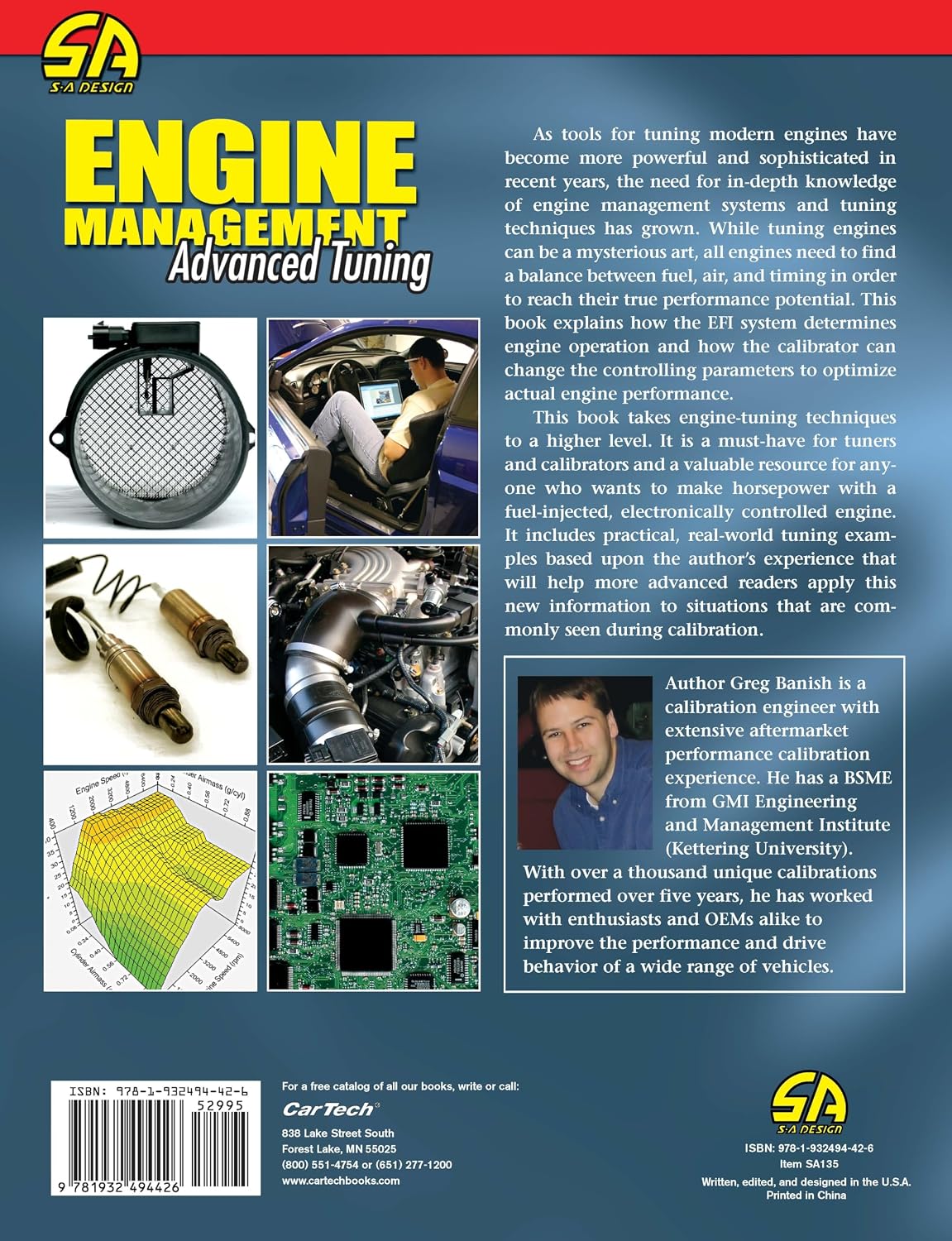
Engine Management: Advanced Tuning — Greg Banish (CarTech Books)
This is the title that gets cited most consistently in performance shop environments, and for good reason. Banish writes from a practitioner standpoint — he’s a professional calibrator, and the book reads like structured shop knowledge rather than academic theory. The coverage of volumetric efficiency tables, lambda targeting (lambda is a normalized way of expressing air/fuel ratio, where 1.0 always equals stoichiometric regardless of fuel type), and the practical mechanics of closed-loop fuel trims is thorough without being overwhelming.
What makes the Banish book particularly useful for this audience: it’s fuel-system agnostic. The principles apply whether you’re running a Holley HP EFI on a 427 big-block or a standalone Haltech on a boosted LS. The chapter on sensor diagnostics — specifically how to distinguish a failing O2 sensor from a legitimate fuel delivery problem — comes up repeatedly in builder forums and professional shop contexts as a reference point rather than a starting point.
Best for: Builders moving from a self-learning throttle-body kit toward a tunable multi-port system. Readers who’ve done one install and want to understand what they just built.
How to Tune and Modify Engine Management Systems — Jeff Hartman (Motorbooks)
Hartman’s approach is more system-oriented than Banish’s. Where Banish focuses on calibration principles, Hartman walks through the full architecture of an EFI system — injector sizing, fuel pressure regulation, MAP sensors (Manifold Absolute Pressure — the sensor that tells the ECU how hard the engine is working based on intake vacuum/pressure), and ignition timing integration — before getting into tuning. For a builder who’s still developing their mental model of how all the components interact, this sequencing matters.
The chapters on injector duty cycle math are particularly practical. Duty cycle describes what percentage of time an injector is held open — at 100% duty cycle, the injector is flowing continuously and you’ve hit the ceiling of your fuel system. Hartman’s treatment of this, including headroom calculations for power adders, translates directly to kit selection decisions. The math he walks through is the same math a shop would use to spec injectors for a 600-horsepower street/strip build.
Best for: First-time EFI converters who want to understand the whole system before diving into calibration. Also valuable for experienced builders who’ve been running EFI intuitively and want to put formal structure behind their instincts.
How to Build Horsepower, Vol. 1 — David Vizard (S-A Design)
This one earns its spot differently. Vizard isn’t writing about EFI calibration — he’s writing about how engines actually make power. But that context is exactly what’s missing when a tuner stares at a VE table and tries to make sense of why cylinder four is consistently pulling lean at mid-RPM. Understanding airflow, port velocity, and combustion dynamics makes the VE table legible in a way that pure calibration instruction can’t.
Experienced builders at the professional level already know this intuitively. Readers who are 6–24 months into their EFI journey often don’t yet — and it shows in the calibrations they produce. Think of the Vizard book as infrastructure. You don’t tune it directly, but everything you tune makes more sense because of it.
By the Numbers: Quick Reference on How These Titles Stack Up
| Title | Author | Strongest Coverage | Ideal Entry Point |
|---|---|---|---|
| Engine Management: Advanced Tuning | Greg Banish | VE tables, lambda, closed-loop trims | Post-first-install tuning |
| How to Tune and Modify Engine Management Systems | Jeff Hartman | Full-system architecture, injector sizing | Pre-install system planning |
| How to Build Horsepower, Vol. 1 | David Vizard | Combustion physics, airflow fundamentals | Any stage — read once early |
What to Read Online — and How to Filter the Noise
Books give you durable frameworks. Online sources give you current calibration data, platform-specific gotchas, and community-validated workarounds. The editorial team at OnAllCylinders.com has published consistently useful EFI fundamentals content — their overview of closed-loop fuel control basics is a clean primer that holds up well alongside the Banish and Hartman texts.
Enginelabs.com runs deeper technical content aimed squarely at performance builders, including lambda targeting strategy for alcohol and E85 blends — relevant if your build involves flex-fuel capability or a dedicated ethanol setup. Their coverage of wideband sensor placement and exhaust collector positioning for accurate closed-loop feedback is the kind of specific, application-level detail that doesn’t make it into general books.
Holley’s own documentation is underrated as a learning resource. The official Sniper EFI installation and tuning guide (available through holley.com product support pages) is written to support the kit, but the underlying explanation of how the system’s self-learning algorithm interacts with your initial configuration settings is genuinely instructive. Builders who read it alongside a Banish or Hartman chapter on closed-loop operation come away with a much cleaner picture of why the ECU behaves the way it does during the first few hundred miles of learning.
For the professional shop context, SAE International’s technical paper archive includes foundational work on engine management systems that’s worth occasional consultation when you’re troubleshooting a problem that has no obvious precedent in the builder literature. It’s not casual reading, but it’s citable and authoritative in a way that matters when you’re making a specification decision for a client’s build.
The Books That Didn’t Make the Cut — and Why
There are several titles in the CarTech and S-A Design catalogs that are platform-specific rather than principle-based — books covering a specific ECU brand’s software interface, for example. These have their place as quick-reference supplements, but they age out as software updates roll through. A book that teaches you how to navigate a specific version of a tuning software is less durable than one that teaches you why the VE table value at 3,000 RPM and 80 kPa matters. Prioritize principles.
Similarly, general-purpose automotive electrical books — while useful for wiring harness work — often treat fuel injection as a minor subsection rather than a system worthy of dedicated coverage. They’re worth having for the sensor wiring and grounding chapters, but they won’t build calibration intuition.
The “If X, Then Y” Decision Rule
This is the part where you stop browsing and start buying. Here’s the honest sequencing:
If you’re completing your first carb-to-EFI swap on an entry-level kit (FiTech Go Street range, Holley Sniper 1 range) and you’re still learning what a MAP sensor does: start with Hartman’s How to Tune and Modify Engine Management Systems. Read it before the install, not after. It will change the questions you ask during the build.
If you’ve already done one or two installs and you’re running a self-learning system but hitting walls on part-throttle drivability or WOT calibration: the Banish book is the gap-filler. The VE table and closed-loop trim chapters will explain what your ECU’s self-learning is actually doing — and where to intervene manually.
If you’re a professional builder or performance shop specifying multi-port sequential systems for street/strip or endurance-racing applications: you likely already know both Banish and Hartman. The Vizard fundamentals book and selective deep-dives into the SAE technical paper archive are where incremental gains live at your level.
If you’re building intuition across the board: read Vizard first, Hartman second, Banish third. Then use the online resources at Enginelabs.com and OnAllCylinders.com to stay current on platform-specific application notes and sensor integration strategies.
The books on your workbench should earn their square footage by making your calibrations better and your troubleshooting faster. The three core titles here do that reliably — and unlike the ECU software they help you understand, they don’t require a firmware update.