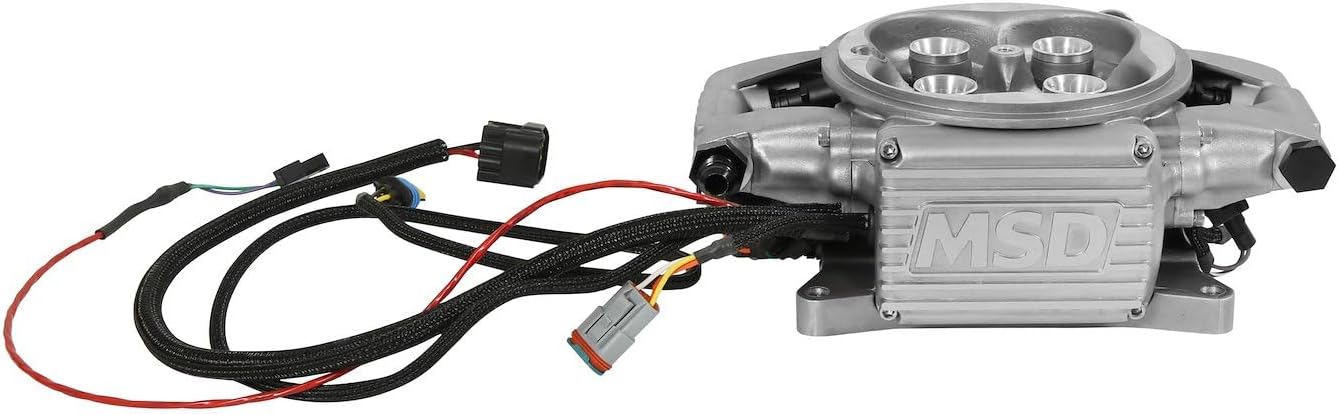
If you’ve been running a carburetor — that’s the mechanical fuel-mixing device bolted to the top of most classic V8 engines — and you’re thinking about switching to EFI (electronic fuel injection, which uses sensors and a computer to precisely meter fuel), you’ve probably already Googled “EFI conversion kit” and landed on prices ranging from $399 to well over $2,500. That spread is real, and it’s not just marketing fluff. It reflects fundamentally different hardware, different tuning philosophies, and very different total project costs once you account for everything the kit listing conveniently leaves out. This article maps every line item — kit, fuel system, sensors, wiring, tuning time — so you walk into the purchase with a real number in your head, not just the price on the product page.
Whether you’re a first-time converter trying not to over-buy, a muscle-car restorer budgeting a pro-touring build, or an LS-swap fabricator specifying a multi-port system for a customer, the math here applies. Let’s work through it tier by tier.
The Kit Price Is the Starting Line, Not the Finish Line
This is the single biggest misconception in the carb-to-EFI conversation. The kit MSRP — say, $699 for a Holley Sniper 1 throttle-body unit — covers the throttle body, the integrated ECU (the small onboard computer), the basic sensor suite, and a wiring harness. What it does not cover is everything else your existing fuel system can’t handle.
Here’s a representative total-cost snapshot across the three main tiers as of May 2026:
| System Tier | Example Kit | Kit Price | Fuel System Upgrade | Ancillaries & Wiring | Tuning | Realistic Total |
|---|---|---|---|---|---|---|
| Entry TBI | FiTech Go Street | $399–$499 | $150–$300 | $75–$150 | $0–$200 | $625–$1,150 |
| Mid Self-Learning | Holley Sniper 1 | $700–$900 | $200–$400 | $100–$200 | $0–$300 | $1,000–$1,800 |
| Premium Self-Learning | Holley Sniper 2 / MSD Atomic AirForce | $1,200–$2,500 | $250–$600 | $150–$300 | $200–$600 | $1,800–$4,000 |
Those ranges aren’t padding. They’re the actual variance you’ll encounter depending on your specific application, your existing fuel system, and whether you tune it yourself or pay a shop.
Fuel System: The Budget Item Everyone Forgets
If there’s one place carb-to-EFI conversions blow their budgets, it’s the fuel system. A carburetor runs happily on 4–7 PSI from a mechanical pump. EFI systems typically need 43–58 PSI, minimum. Your old mechanical pump is not salvageable for this job.
What you’ll need:
-
In-tank or inline high-pressure fuel pump: Entry-level returnless setups (like those on FiTech systems) can use a quality inline pump in the $80–$150 range. Mid-tier and premium builds benefit from an in-tank retrofit pump, which runs $150–$350 installed depending on your tank design. If you’re building toward a return-style system (more stable fuel pressure, better for high-horsepower applications), budget an additional $50–$100 for a return line and fittings.
-
Fuel pressure regulator: Many kits include one. If yours doesn’t, or if you’re building a return-style system, add $40–$120 for a quality adjustable unit. Per published installation documentation from Holley Performance, their Sniper 2 system requires a regulated return-style fuel delivery setup when used on applications above approximately 650 HP.
-
Fuel filter: Don’t overlook this. A 10-micron pre-filter protects injectors. Budget $20–$50.
-
Fuel lines: If your existing hardlines are rubber fuel hose running at carb-spec pressure, replace them. Braided AN lines are the right call for any performance application. A basic front-to-rear retrofit with fittings runs $80–$200 depending on line length and fitting count.
Total realistic fuel system upgrade cost: $150–$600. The higher end applies to performance builds adding return lines, billet fuel rails, or in-tank pump retrofits on tanks without existing baffling.
Sensors, Oxygen, and the Closed-Loop Question
“Closed-loop” fuel control is what separates modern EFI from fancy carburetors. In a closed-loop system, the ECU reads an oxygen sensor (O2 sensor) in the exhaust to see whether the engine is running rich (too much fuel) or lean (too little), then adjusts fuel delivery in real time. Without this feedback loop, you’re running “open loop” — essentially a programmed guess.
Every self-learning EFI kit — FiTech, Holley Sniper, MSD Atomic — includes a wideband O2 sensor as part of the kit. This is a meaningful feature: wideband sensors measure the exact air-fuel ratio across the full operating range, not just rich/lean toggle like the narrowband sensors on older OEM systems. Per Engine Labs’ EFI conversion guide, the integrated wideband is one of the primary reasons modern self-learning throttle-body units can tune themselves to a usable baseline within the first 20–50 miles of operation.
What you may need to add:
- Coolant temperature sensor (CTS) bung: Most kits include the sensor but not always the bung if your intake doesn’t have one. A bung weld costs $20–$60 at a machine shop.
- Manifold absolute pressure (MAP) sensor: Integrated in most TBI units. In multi-port sequential systems (Holley HP EFI, FiTech Ultimate LS), it’s external — usually included, but verify before ordering.
- Throttle position sensor (TPS) calibration: Included in kit harnesses. Not an added cost, but confirm compatibility with your throttle linkage geometry.
For premium port injection builds running the Holley HP EFI ($2,200+) or Holley Dominator EFI, additional sensors — individual cylinder head temperature sensors, dual O2 sensors for headers with separate collector exits, boost sensors for forced-induction applications — can add $100–$400 to the sensor budget.
Wiring, Relays, and the Stuff That Actually Takes Time
The wiring harness included with a kit covers the basics: ECU power, sensor inputs, injector outputs, and IAC (idle air control) motor connections. What it doesn’t cover is integration with your existing vehicle harness, ignition system, and any accessories like electric fans or fuel pump relays.
Budget line items here:
- Relay and fuse block for dedicated EFI power circuit: $30–$80. Every reputable installer writing on OnAllCylinders and Hot Rod Network recommends a clean, dedicated power feed directly to the battery rather than tapping into existing underhood circuits.
- Ignition timing integration: If you’re retaining a distributor (common on carbureted small-block builds), you’ll need to connect the ECU’s tach/trigger input. Most kits handle this with the included harness. If you’re switching to a crank trigger setup for accurate timing on high-compression builds, add $150–$300 for the trigger kit and timing calibration.
- Electric fan trigger: Many builds convert to electric cooling fans during an EFI swap for tighter thermal management. Budget $120–$350 for fan assembly, $30–$60 for a relay harness.
- Gauge and data display integration: The Holley Sniper 2 and MSD Atomic AirForce systems include touchscreen displays that double as tuning interfaces. Entry-level systems like the FiTech Go Street use a handheld unit. Neither replaces a quality wideband gauge for shop diagnostics, which runs $160–$280 (Innovate Motorsports and AEM are the commonly cited options in builder forums and published shop guides).
Realistic total for wiring and ancillaries: $75–$400, depending on scope.
Tuning: Where Self-Learning Earns Its Premium
This is the sharpest cost difference between tiers, and it’s often invisible in the comparison-shopping phase.
Entry and mid-tier self-learning systems (FiTech Go Street, Holley Sniper 1) are specifically engineered for street-only applications where “close enough” is good enough. Per OnAllCylinders’ overview of self-learning EFI systems, these units adapt fuel tables in real time using closed-loop O2 feedback, and owners consistently report achieving stable, drivable tune files within the first tank of fuel. For a stock or mildly built 350 or 383 small-block, this works. You’re not paying for dyno time. Tuning cost: $0 if you do it yourself; $200–$400 if you want a baseline dyno pull to verify.
Mid-to-premium systems — Holley Sniper 2, MSD Atomic AirForce, and especially the Holley HP EFI — serve higher-horsepower and more complex applications where self-learning can only get you partway there. A cam-heavy 496 big-block with a large-duration solid roller, a turbocharged LS, or a nitrous-assisted 427 will challenge any self-learning algorithm at the edges of the operating map. Professional dyno tuning becomes necessary, not optional.
Per Motor Trend’s coverage of pro-touring builds, shop dyno tuning on a standalone EFI system typically runs $400–$900 for a street/strip tune and can reach $1,500–$2,500 for full wide-open-throttle pull mapping with boost or nitrous calibration. Factor that in before you spec a $2,500 kit and assume the software does all the work.
The Decision Framework: If X, Then Y
Here’s where this lands after accounting for every line item:
If your build is a stock-displacement or mildly modified V8 on a street-only daily driver or weekend cruiser: Start with the FiTech Go Street or Holley Sniper 1. Your all-in number will be $800–$1,500. The self-learning tuning is genuinely good enough, the fuel system upgrade is straightforward, and the return on investment over a carb — better cold starts, consistent idle, better fuel economy — shows up immediately.
If your build has a performance cam, aluminum heads, or you’re planning a tow or mountain-pass driving profile: Step to the Holley Sniper 2. The expanded tuning authority, better idle control at large LSA camshaft specs, and dual-channel O2 capability are worth the additional $400–$600 over the Sniper 1. Budget $1,500–$2,500 all-in and plan for one dyno session.
If you’re building a pro-touring car, a dedicated strip car with street plates, or doing an LS swap into a chassis that demands tight tunability: Spec the Holley HP EFI or MSD Atomic AirForce from the start. Multi-port sequential injection (each cylinder gets its own injector, firing in sequence) delivers better cylinder-to-cylinder fuel distribution, which matters above 500 HP and on engines with significant port variation. Budget $2,500–$4,500 all-in and commit to professional dyno tuning. It’s not the place to cut corners.
The carb-to-EFI decision isn’t really about the kit price. It’s about whether your total build budget accommodates the fuel system, the sensors, the wiring, and the tuning that the kit requires to actually work. Run the full number before you order, and the right kit for your application becomes obvious.