If you’re new to EFI swaps, here’s the short version: an inline fuel pump is an external pump mounted somewhere along your fuel line — between the tank and the engine — that pressurizes fuel before it reaches your injectors. Unlike a traditional carburetor setup that runs at a lazy 6–8 PSI, modern electronic fuel injection systems demand 43–65 PSI of steady, regulated pressure. The pump is the heartbeat of the whole system, and choosing the wrong one can mean a stalled build, a failed dyno pull, or — in the worst case — a fire hazard. This article walks you through what separates a $60 pump from a $400 one, which category actually earns your money, and where the popular 300LPH (liters per hour) spec can mislead even experienced builders.
| EDITOR'S PICK[Aeromotive 3.5 GPM Inline Fuel](https://www.amazon.com/dp/B07SLLLCSR?tag=greenflower20-20)… | Mid-tier[EVIL ENERGY External Inline Fue](https://www.amazon.com/dp/B0D1KH5YJH?tag=greenflower20-20)… | Budget pickGSL392 Inline Fuel Pump & 58 PS… | |
|---|---|---|---|
| Flow Rate | 3.5 GPM | 300LPH | 255LPH |
| Pump Type | Brushless spur gear | — | — |
| Pressure Regulator | — | — | ✓ |
| Fuel Compatibility | Gas, E85 & Methanol | — | — |
| Fittings | — | — | 6AN |
| Price | $1,583.96 | $60.99 | $58.99 |
| See on Amazon → | See on Amazon → | See on Amazon → |
Why “300LPH” Doesn’t Mean What You Think It Does
The 300LPH flow rating is everywhere right now — budget units, mid-tier units, and premium pumps all claim it. The number comes from free-flow bench conditions: zero backpressure, ambient temperature, no restriction. Your actual EFI system never operates that way.
Flow rates drop meaningfully as pressure climbs. As detailed in Engine Labs’ comparison of inline versus in-tank fuel pumps (published at enginelabs.com), a pump rated at 300LPH at zero PSI may only flow 220–240LPH at 58 PSI — the operating pressure of a typical LS throttle-body or multi-port system. Add summer underhood temperatures, a restrictive pre-pump filter, and a long fuel run, and you’re losing another 10–15% before the fuel even reaches the rail.
By the numbers:
- 300LPH free-flow → approximately 230LPH at 58 PSI (per Aeromotive published product specifications)
- 255LPH free-flow → approximately 190LPH at 58 PSI (typical budget-tier published specs)
- Rule of thumb: 10 HP requires roughly 0.5 LPH at 100% duty cycle, per On All Cylinders’ EFI fuel system primer published at onallcylinders.com
- A naturally aspirated 500 HP LS needs approximately 50 LPH minimum at operating pressure — most 255LPH pumps have adequate headroom; a 300LPH label does not automatically mean “better”
The trap is buying a 300LPH budget pump because the spec sounds beefy, then running it near its pressure limits on a mildly boosted application. That’s where failures cluster — and it’s where the distinction between budget, mid-tier, and premium hardware becomes load-bearing.
Comparing the Tiers: Budget, Mid-Tier, and Premium Inline Pumps
H3: Budget Tier — The 300LPH Brushed Pump
Budget inline pumps in the 300LPH class have built a real reputation as first-install staples — and that reputation is partly deserved. Owners consistently report clean installations, solid fit with standard 3/8-inch line setups, and reliable initial pressure readings in the 58–60 PSI range. For a naturally aspirated LS swap running a Holley Sniper 1 or FiTech Go Street, a budget brushed pump gets the car running and the closed-loop fueling dialed in without drama.
The problem shows up after the break-in window closes.
Across aggregated owner feedback, a significant minority of budget brushed pumps exhibit one of two failure modes: a hard failure before the 12-month mark, or a progressive noise increase that begins around weeks two through four and escalates steadily. The noise pattern often precedes failure — in a brushed DC motor, carbon brushes begin wearing against the commutator at startup. During the first days, the brushes seat and contact becomes more consistent, so the pump may actually run quietly early on. Once the brushes wear past the break-in zone, electrical contact becomes less even and motor vibration increases. Progressive noise after an initial quiet period is a leading indicator of accelerated wear, not merely a nuisance.
One additional data point worth flagging: at least one documented install reported a budget unit delivering 80 PSI when the pump’s stated pre-set was 75 PSI. That 5–7% overshoot is within what most EFI regulators can compensate for, but it raises a question about factory QC consistency — relevant if you’re pairing a budget regulator with a budget pump.
The honest summary on budget brushed 300LPH pumps: They are a legitimate entry point for naturally aspirated swaps on a tight budget. Treat them as consumables with a 12–18 month replacement cycle on a daily driver, not as a long-term hardware investment.
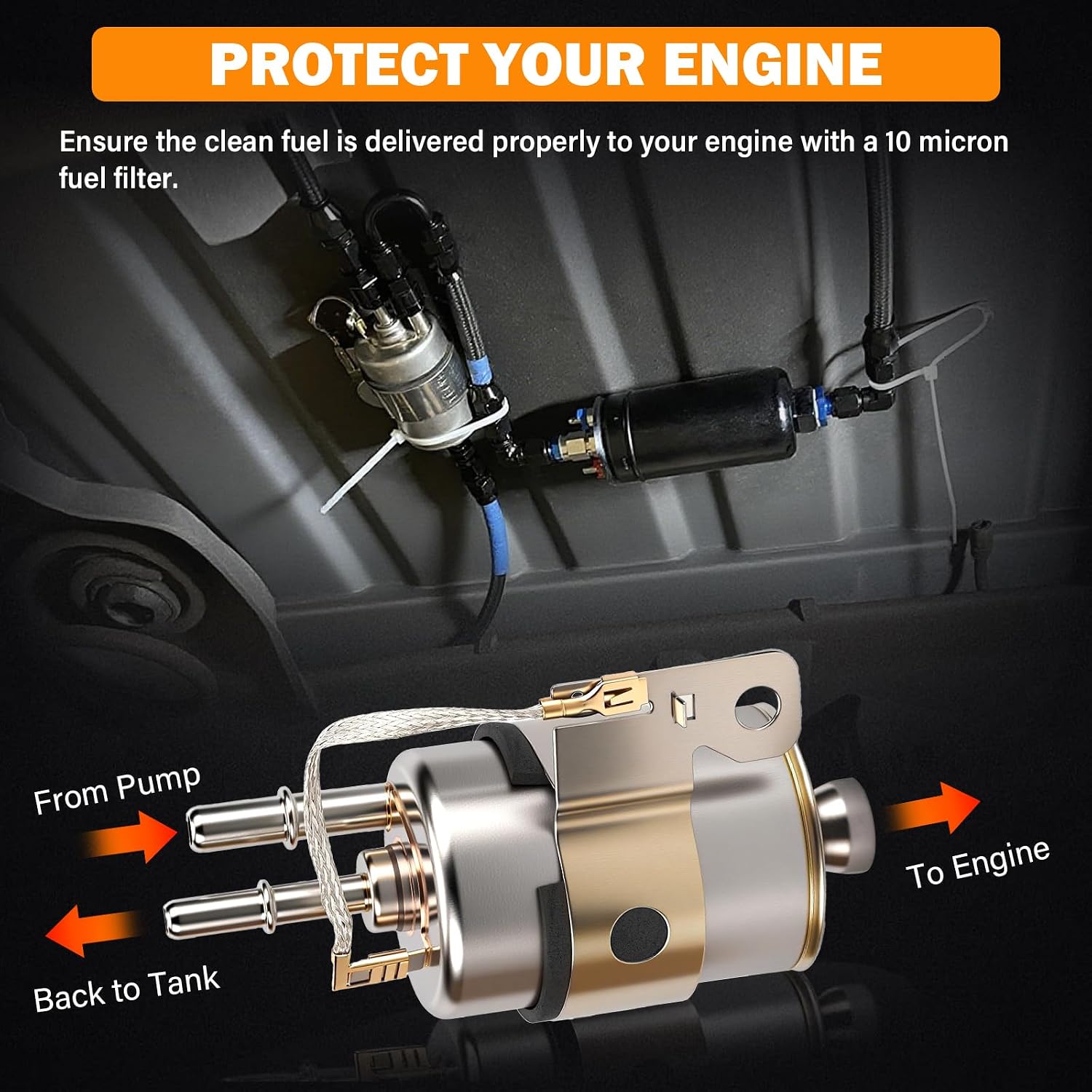
GSL392
$58.99
In stock on Amazon
Check price on AmazonH3: Mid-Tier Tier — Combo Kit (Pump, Filter, and Regulator Integrated)
The GSL392-style combo kit — a pre-assembled unit integrating a pump, inline filter, and adjustable regulator in a single bracket — consistently earns praise from EFI conversion newcomers, and the praise is legitimate. For a builder who has never plumbed a fuel system from scratch, eliminating three separate components and their associated fittings, hose segments, and mounting decisions is genuinely valuable. Holley’s Sniper EFI installation documentation (Holley Performance, Sniper EFI Installation Manual, 2024) acknowledges combo kits as a valid simplification path for returnless-converted carbureted chassis.
The flag that experienced builders raise: the integrated filter in these kits is designed as a secondary filter, not a primary one. When there’s no in-tank fuel pump with a sock filter upstream — which describes most classic muscle car tanks — the combo kit’s integrated filter is doing primary filtration work it wasn’t sized for. Debris loads from old tanks, rust particles, and varnish will clog it faster than expected, and a clogged filter on the pressure side of the pump starves the injectors.
The fix is simple: add a dedicated pre-pump strainer filter upstream of the combo unit. But it’s an additional step that the kit’s “all-in-one” positioning doesn’t always make obvious to first-time buyers.
Per On All Cylinders’ fuel system basics coverage for EFI conversions (onallcylinders.com), separate components are the preferred architecture for builds that expect to grow in power or be tuned iteratively. Combo kits are the right call when simplicity at initial installation is the priority and the builder does not anticipate significant system changes.
Decision rule on combo kits: If your build has a clean, recently-lined or new fuel tank with a functional in-tank sock strainer, the GSL392-style kit is a legitimate convenience win. If you’re pulling fuel from an original, unrestored tank, add the pre-pump strainer filter before you button it up.
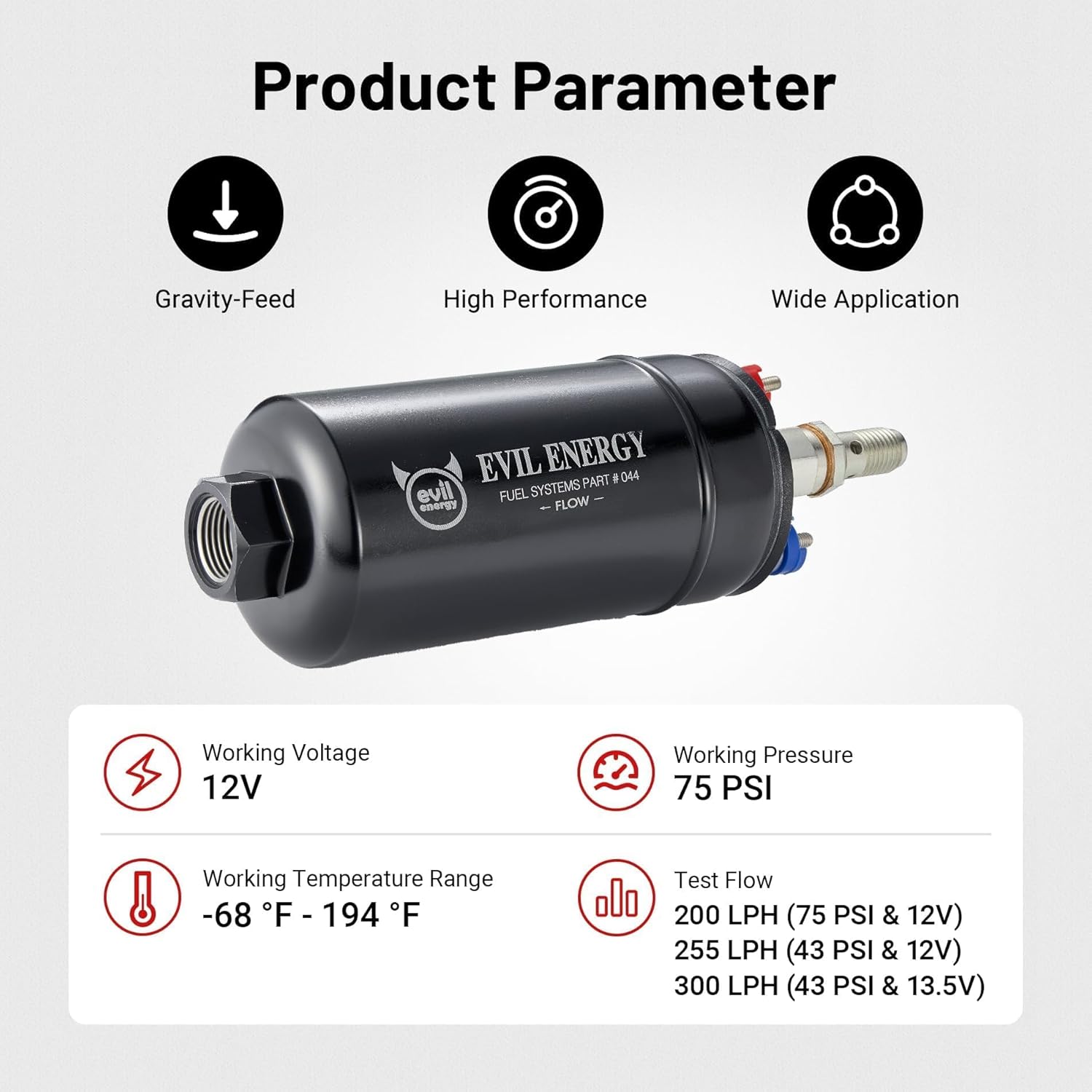
EVIL
$60.99
In stock on Amazon
Check price on AmazonH3: Premium Tier — Aeromotive Brushless Inline Pump
The Aeromotive brushless inline pump occupies a different category entirely — not just in price, but in engineering philosophy. The brushless motor design eliminates the friction wear mechanism that causes most budget pump noise and failure. There are no carbon brushes degrading against a commutator; the motor is magnetically driven and runs measurably cooler under sustained load.
The single most instructive use case for this pump is a boosted application — specifically a turbocharged LS running 90 PSI base fuel pressure. That’s a scenario where budget pumps fail silently: they maintain pressure initially, then begin dropping delivery volume without triggering a fuel pressure warning, causing lean conditions that show up as detonation before the owner knows the pump is marginal.
What distinguishes the Aeromotive brushless unit in that environment is variable-speed pressure control — the ability to modulate pump speed based on demand rather than running at full voltage continuously. On a street-driven boosted car, this means the pump isn’t hammering at maximum RPM during a 35 MPH cruise, which extends service life dramatically and reduces the noise floor in daily operation. Per Aeromotive’s published product technical documentation (Aeromotive Inc., Brushless Fuel Pump Technical Overview, 2025), the brushless series is rated for continuous duty at full operating pressure — a distinction that matters when comparing “300LPH” claims across tiers.
Hot Rod Magazine’s EFI pump selection coverage (hotrod.com) reinforces this point: brushless pump technology is not simply a premium-tier upsell but a fundamentally different durability equation, particularly above 60 PSI base pressure.
The tradeoff is cost and complexity. The Aeromotive brushless unit requires a PWM (pulse-width modulation) controller to unlock the variable-speed benefit. Buying the pump alone without the controller runs it at fixed speed and partially negates the advantage. Budget accordingly.
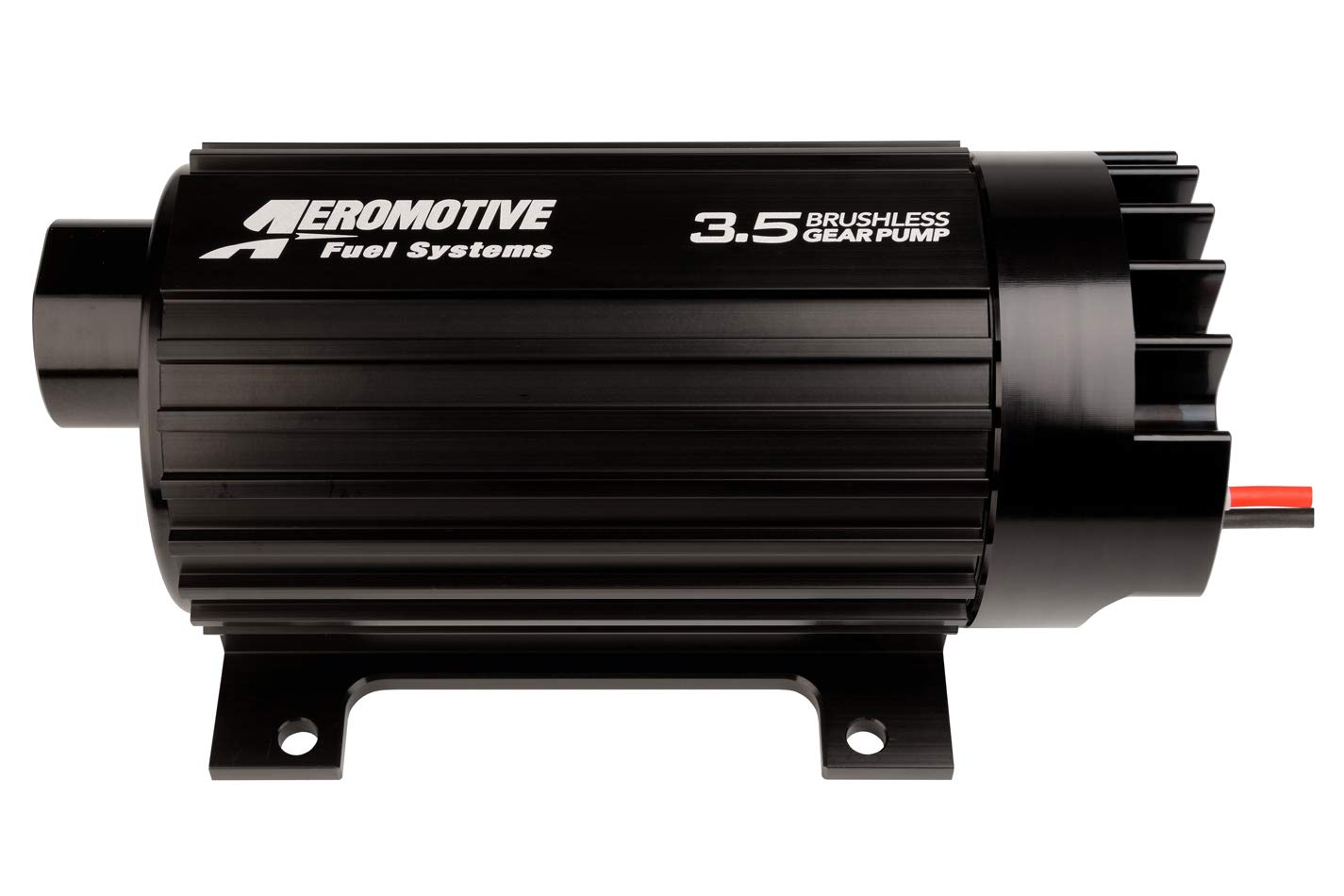
Aeromotive
$1,583.96
In stock on Amazon
Check price on AmazonIf X, Then Y: A Decision Framework
| Your situation | The right call |
|---|---|
| N/A LS swap, street only, budget under $150 | Budget 300LPH brushed pump — budget for replacement at 18 months |
| Daily driver, 400–550 HP N/A, want to set it and forget it | Mid-tier combo kit with clean tank; add pre-pump strainer |
| Boosted application, 60+ PSI base pressure | Aeromotive brushless — variable-speed advantage is load-bearing here |
| First EFI conversion, clean tank, want simplicity | GSL392-style combo kit — add a pre-pump strainer if tank is original |
| Budget pump making noise after 2 weeks | Start the replacement process now; do not wait for full failure |
As Engine Labs noted in their inline versus in-tank pump comparison (enginelabs.com), the pressure at which a pump actually operates — not its free-flow bench rating — determines whether you have real headroom or are running the unit at the edge of its capability every time you accelerate.
Frequently Asked Questions
How long do budget 300LPH inline pumps realistically last on a daily-driven LS swap?
Based on aggregated owner reports, a budget brushed inline pump on a daily driver at 58–60 PSI should be budgeted for a 12–18 month service life. Some owners report longer — occasionally two to three years — but the failure curve steepens sharply in year two. If you’re doing a daily driver build, either plan the replacement interval into your maintenance calendar or step up to a brushless unit.
Why is my new inline fuel pump louder after two weeks than it was on day one?
This is the most consistent red flag in early-failure brushed pump accounts. During the first days of operation, carbon brushes seat against the commutator and mechanical contact becomes more consistent — so the pump can actually run quietly early. Once the brushes begin wearing past the break-in zone, electrical contact becomes less even and motor vibration increases. Progressive noise after an initial quiet period is a leading indicator of accelerated wear, not merely a nuisance. If your pump is louder at week three than it was at startup, begin planning your next step.
Can a 255 or 300LPH pump overwhelm a budget fuel pressure regulator?
Yes, in a meaningful way. A pump delivering more volume than the regulator’s bypass valve can handle will cause rail pressure creep — the rail pressure rises above target because the regulator cannot bleed off excess fast enough. On a naturally aspirated engine running a self-learning throttle-body EFI system, the ECU will compensate for moderate overpressure, but it is working harder than it should. Size your regulator to the pump’s actual maximum output, not its nominal rating, and verify fuel pressure with a known-accurate mechanical gauge at initial startup. Holley’s Sniper EFI Installation Manual (Holley Performance, 2024) recommends confirming fuel pressure before first startup and rechecking under load — guidance that applies regardless of which pump tier you’ve chosen.
What is the difference between a combo pump/filter/regulator kit and buying separate components?
A combo kit bundles the pump, an inline filter, and an adjustable pressure regulator into a single pre-assembled bracket. The advantage is installation simplicity — fewer fittings, fewer decisions, one mounting point. The tradeoff is configurability: when one component needs replacement or upgrade, you’re often replacing or working around the entire assembly. Separate components let you upgrade the regulator without touching the pump, or swap to a higher-flow pump without replumbing the entire filter circuit. Per On All Cylinders’ EFI conversion basics coverage (onallcylinders.com), separate components are the preferred architecture for builds that expect to grow in power or be tuned iteratively — combo kits are the right call when simplicity at initial installation is the priority and the builder doesn’t anticipate significant system changes.
Does a brushless pump require any special wiring compared to a standard brushed unit?
Yes. To take full advantage of variable-speed operation, a brushless inline pump like the Aeromotive unit requires a PWM controller wired between the pump and the power supply. Without the controller, the pump runs at a fixed speed and the efficiency and longevity advantages are reduced. The controller itself is a relatively straightforward addition — typically a small module that takes a signal from manifold pressure or the ECU — but it is an extra component and an extra wiring task that budget and combo-kit installs do not require. Factor both the controller cost and the wiring time into your build budget when pricing a brushless system.